A Haibun: Family Tradition

From the time our children were two and four, we’ve held hands before our evening meal and sung a song called The Circle of Love. With a simple and happy tune, the words go like this:

“The circle of love goes around and round
the circle of love goes around.
Reach out your hands someone needs you.
The circle of love goes around. Amen.”

It’s not by others’ standards, a real table grace. Grace is often defined as the free, unmerited favor and love of God toward humanity. And a short prayer before a meal is often called “saying grace”. For us, this singing together before supper was and always is a moment to celebrate family. Smiling at each other, sometimes grinning, we sing loudly and with energy. What we’re really singing about is the unconditional love and happiness we share. No matter the food – from cheesey chicken casserole to shrimp scampi to Thanksgiving turkey, The Circle of Love was always the first course of the meal.

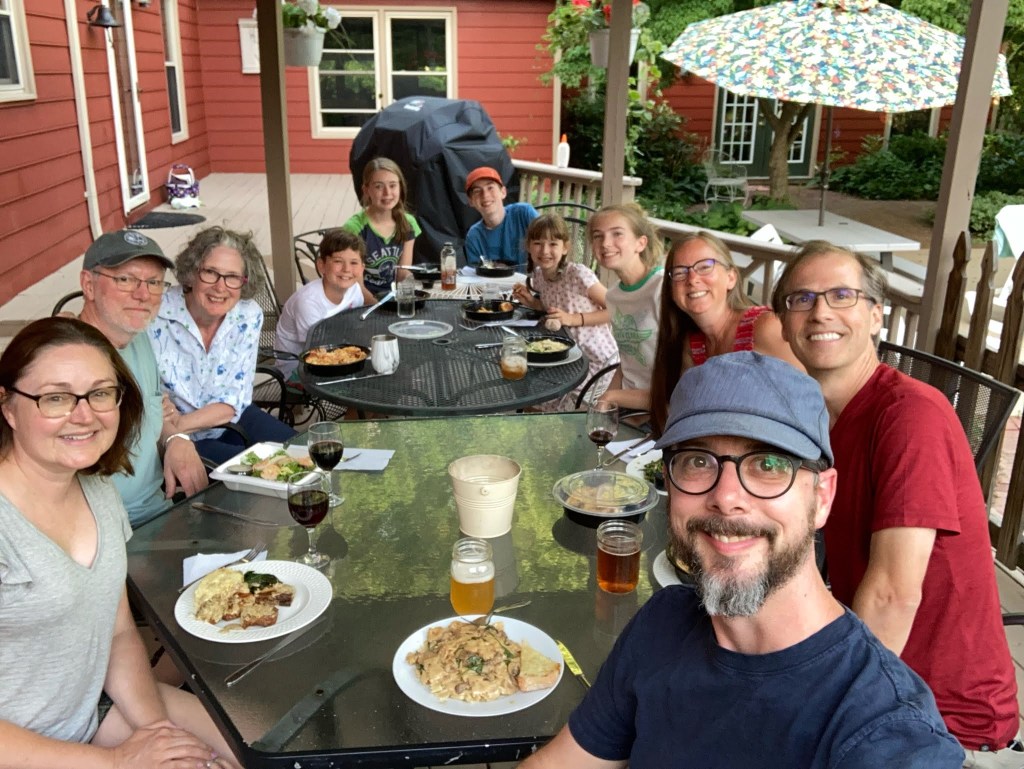
Now, approaching our octogenarian years, with five grandchildren who are twenty, eighteen, and fifteen, and our children and their wonderful spouses in their fifties, we treasure the rare times we are all together. The eleven of us, or a fewer number on occasions when busy lives and miles intervene, still carry on this tradition. When we come to the table for an evening meal, no matter the happenings of the day, the first thing we do is join hands. And then we sing, loud and clear. Grateful for each other and for the meal we share.

Wild flowers in fields
different shapes, sizes, colors
always face the sun.

Written for dVerse, the virtual pub for poets around the globe. Today Punam is hosting Tuesday Poetics presenting us with the following prompt: “For today’s Poetics, I would love a presence of food in your poems. You can employ any form but touch upon food; vegetables, fruits, meat, dairy, desserts you love or hate. It could be about why you love/abhor cooking/baking, your most memorable/miserable meal ever, your relationship with food…the possibilities are endless.” No particular form or length is required.
A Haibun is a Japanese poetic form that combines prose with a haiku.
I guess you could say I’ve written about my family’s relaionship with the evening meal!

Photo is from a family gathering about six years ago.

Detour

“No man ever steps in the same river twice, for it’s not the same river and he’s not the same man.” Heraclitus

Some years back we found ourselves near the town I grew up in – Waukegan, Illinois. I’d not been there in decades. We decided to take a detour in our planned trip and drive by some of my old haunts.

Sadly, the house I lived in for my first nine years was in a state of disrepair. Rickety porch steps, missing shingles. My mother’s beloved lilac bushes were no more. The downtown where I’d “scooped the loop” in the front seat of an old Chevy was barely recognizable. Not one store name was the same. Most jarring was my walk through the Catholic church I grew up in. How could it be so small? I remembered lighting candles inside a hushed space – a side grotto/cavern made of dark rock. There I stood, inside the grotto, looking at battery operated candles and grey plastic simulated stone walls. After lighting a candle and saying a small prayer for my mother, I decided to end our nostalgic tour. I wanted to keep the rest of my memories intact.

stream rushes surely
rocks tumble and change their shape
nothing stays as is


Frank is hosting Haibun Monday at dVerse, the virtual pub for poets around the globe. His prompt for today is to “imbue our haibun with mono no aware. Write on any topic that you like as long as your haibun embodies that wistful sadness marking the beauty of transience.” A haibun combines prose and a haiku. Image is a photo I took some years back on one of our vacations.

I was lucky . . .

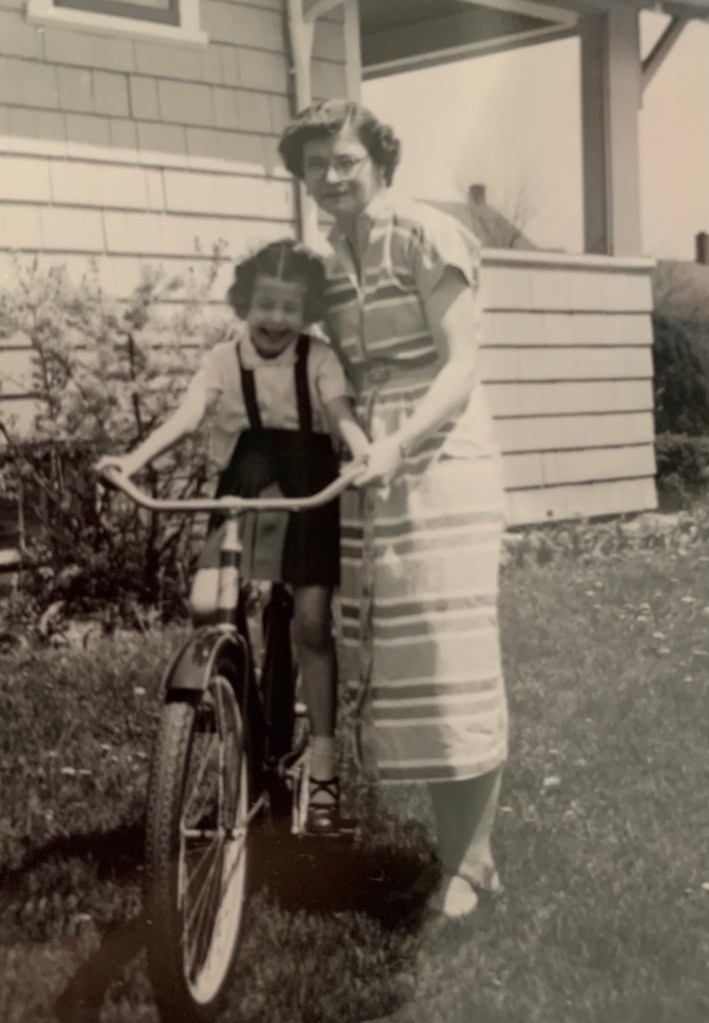
The summers of my privileged youth were filled with riding bicycles with my best friend, June; drinking from the garden hose; drawing hopscotch grids with colored chalk; climbing Mrs. Jester’s apple trees; running through sprinklers in the back yard; and fishing off the Lake Michigan pier with my dad. Once every summer, my mom bought a box of popsicles and doled them out to me and my friends. Everyone else fought over the red ones. I always had the yellow ones to myself. I guess nobody else liked banana.

hot city summer
steam hovers over pavement
tempers flare, guns pop


Frank is hosting haibun Monday at dVerse, the virtual pub for poets. Today he asks us to consider summer. Photos from my childhood, in the early 1950s. Pub opens at 3 PM Boston time. Come join us!

Haibun: one or two paragraphs of succinct prose, usually biographical in nature, followed by a haiku that amplifies the theme, but does not duplicate the prose.

Junie’s House

I remember Junie’s house. She was my best friend until we moved away when I was in third grade. I remember her house as comfortable. A heated enclosed front porch held all her well-used dolls and dress-up clothes. Her grandma always sat in the living room in an old wooden rocker. She was tiny, silent and mysterious to me. Junie’s big dining room was crammed full by just three things: an old upright piano with lots of sheet music on its top, a huge dining room table covered in papers and books and magazines, and a large sidebar that had mail on it and a mish mash of other things. The kitchen was huge. I was entranced by the modern washing machine and dryer next to the big gas stove. That was the only washer and dryer I’d ever seen – until we moved to our new house. Junie had a special white metal chair at the table. It sat her up high and was battered and dented. I was always jealous of it when I had to sit on a regular chair on top of books. Junie’s mother, Bertha, was my mother’s best friend. I remember her in the kitchen, wearing an apron around her ample waist, always happy. She made yummy pb&j sandwiches and cut off all the crusts for us. Junie shared a bedroom with her older sister. First door on the right when you got upstairs. There was a dressing table between the two twin beds, covered with Auberdeen’s lipsticks, dried corsages, and fingernail polish bottles. And strangely, I remember the doorknobs in her house. They were big and white and looked like china to me. I have no idea what the doorknobs in my own house looked like.

I have no photos of Junie’s house; nor did my mother. I find it interesting that I remember it in so much detail. And that I use the word “comfortable” to describe it. But that’s in juxtaposition to my mother’s tiny glass animal collection on display in our dining room and my collection of story book dolls kept on glassed in shelves in my bedroom.

winter storm rages –
farm cat beckoned into house
turns back to old barn

Written for Haibun Monday at dVerse, the virtual pub for poets around the globe. Today I host and ask people to “travel down memory lane” with a simple exercise. Close your eyes for a few moments and go back in time to your earliest memories NOT recalled by virtue of a photo or family lore. Now start jotting them down. You’ll be surprised what you come up with. When I first did this exercise, I actually drew out what the first house I lived in was like: rectangles for rooms. Then I labelled them: my room, parents’ room, brother’s room, living room, dining room, linen closet in hall — and suddenly I remembered climbing up in there to hide from my mom! After jotting things down, choose one memory to share.
Remember, a haibun is: 2 or 3 paragraphs of succinct prose that must be true (cannot be fictional), followed by a haiku that is somehow related to the prose and includes a seasonal reference.

Photo is one of the few I have of me and my friend Junie. Junie is on the left. An interesting fact we found out about 5 years ago when we reunited after some 60+ years, we were married on the same date! That’s a Tiny Tears doll she’s holding. Anyone remember those?

Haibun for 2021

As I think back on new beginnings in my life, I’m struck by how self-centered or family oriented they all were. Graduations, the births of our children and grandchildren, weddings, birthdays, rejuvenatement – never say retirement. New Year’s Eves don’t really come to mind as momentous occasions – until this year.

As we have in so many years past, George and I watched the crystal ball drop in New York City’s Times Square from the comfort of our home. We counted down the last ten seconds of 2020. But this time, when we hugged in 2021, I was literally overcome with emotion. Tears flowed and I clung to George. I was surprised at the depth of my emotional response until I realized what it encompassed. Hope on a global scale. Hope in the form of a vaccine. Hope that millions will escape misery, ill health, and untimely deaths. This moment in our lives, was a moment shared round the globe. It was so much bigger than us sitting on the couch. We were simply a microcosm of a weary world, rejoicing in hope.

snow pack melts in sun
trickle grows to waterfall –
like hope rushing forth

Today, I’m tending the bar at dVerse, the virtual pub for poets around the globe. We open 2021 with Haibun Monday. My prompt is to write about new beginnings. Think about how that phrase may relate to you. Perhpas you’re reminded of a new job, new garden growth, a new season. Anything that comes to mind in terms of a new beginning. BUT . . .
. . . I remind people that a haibun must meet certain requirements:
* 2 or 3 succinct paragraphs of prose that must be true

* followed by a traditional haiku.
Traditional means much more than simply 3 lines of 5-7-5 syllables.
Come join us at 3 PM Boston time and find out what a traditional haiku really is!

Photo: taken on our South America/Antarctica cruise in January 2018. Vincennes Rosales National Park, in Puerto Montt, Chile.

Life’s Design

It seems to me, there is a map to our lives. Imagine that we can draw it on a grid. Each cell is a day. Cells filled in with bright colors are to-dos and pay-attention-tos. Some neon need-tos are so intense they cause a glare. Blank cells appear in chunks. Free days. Times to play, cogitate, and just be.

My early years were chock full of free days. But ultimately, they almost disappeared. The grid became so colorful, it was blinding. Full of responsibilities, accountability. Children to raise. Professional ladder to climb. Even in those few empty cells, vacation days, I found myself calling in to the office; answering emails. The job tinted even the blank chunks on my grid.

Now in rejuvenatement, never say retirement, filling in the grid is largely my choice. And as I look at it, I suddenly begin to understand, the map of my life is not all my own doing. The socioeconomic term “privilege” comes to mind. Circumstances of birth, ethnicity, geographical location – all have affected my life and enabled me to come to this point where the grid is much easier on the eyes. And in these days of Covid-19, I understand even more, how blessed I have been.

for the lucky ones
summer yields bountiful crops –
others slowly starve

Written for Haibun Monday at dVerse, the virtual pub for poets. Today Kim asks us to respond, in some way, to the image above, “Broadway Boogie Woogie”, created by Piet Mondrian, displayed at New York’s Museum of Modern Art.

Haibun: 2 or 3 paragraphs of prose followed by a haiku that includes reference to a season.

Never to be the same . . .

In 2005, we rented a vacation home on the Big Island. Our back yard included an ocean inlet to Champagne Pond where at low tide, we swam with glorious sea turtles.

Our most amazing adventure was a lava hike, climbing over fields of hardened basalt. Eventually we came upon fissures where hot lava pooled, spit, hissed, bubbled and oozed ever so slowly. Using flashlights on the return walk, lava glowed red-orange in the distance, as if a jack-o-lantern was lit across the horizon. We also hiked across a caldera, over “waves” of Pele’s hair. We found a small delicate fern peeking out of a crevice. Hawaiian breezes deposit plant life in nooks and crannies. Life reappears in the midst of desolation.

Pele’s anger erupted violently in 2018. Kilauea spewed plumes 12,000 to 30,000 feet high. Fissures burst open. Lava flows destroyed over 700 homes. Lagoon House: A Piece of Paradise, the vacation home so many people enjoyed over the years, was entombed in thirty feet of boiling lava, which eventually cooled to impenetrable basalt. As the owner wrote, the coastline is forever changed. I wonder, how long it will be before a single fern, and then a tree, and then a grove of trees take root. Will the memory of Pele’s reckoning disappear? Will humans be enticed to rebuild what was once called Leilani Estates – and is that even possible?

I look at photos
housebound during Covid spring ~
Pele sleeps again

* Pele is the Hawaiian goddess of volcanoes.

Day 22: National Poetry Writing Month. Toads asks us to choose one of four given quotations to motivate our poem of any form.  I wrote a a haibun.

Photos from June 2005 trip with our children to Hawaii’s Big Island. Our guided lava hike across Kilauea, at the time, the longest continuously active volcano in the world, now seems ridiculously dangerous and foolish – given the horrific occurrence in December 2019 at New Zealand’s White Island.

In the first photo, I’m waving goodbye to the incredibly beautiful back yard at our vacation rental, the night before we returned home. Little did I know that 13+ years later, this scene would be nonexistent.

QUOTATION USED TO MOTIVATE POST:  “A fresh and vigorous weed, always renewed and renewing, it will cut its wondrous way through rubbish and rubble.” William Jay Smith

Haibun in the midst of these troubling times

It was to be a celebratory long weekend in Washington DC. We would all gather in a large rental house to celebrate our fiftieth anniversary. Our children. Their children. The Circle of Love as we call ourselves. Dinner reservations made. Photographer arranged. So long in the planning. Fifty years in the making.

And then the unthinkable took hold across the globe. It became clear we would not be “eleven total in raucus revelry.” Instead we are sheltering in place in our individual homes. Venturing out for groceries. Taking our own walks on separate unbeaten paths in three different cities, in two different states. We do connect with phone calls and Facetime to insure all are well. We share tales of in-house projects, board games, and home schooling. Love is always heard in our eleven voices  – no matter the distance. And for this we are grateful.

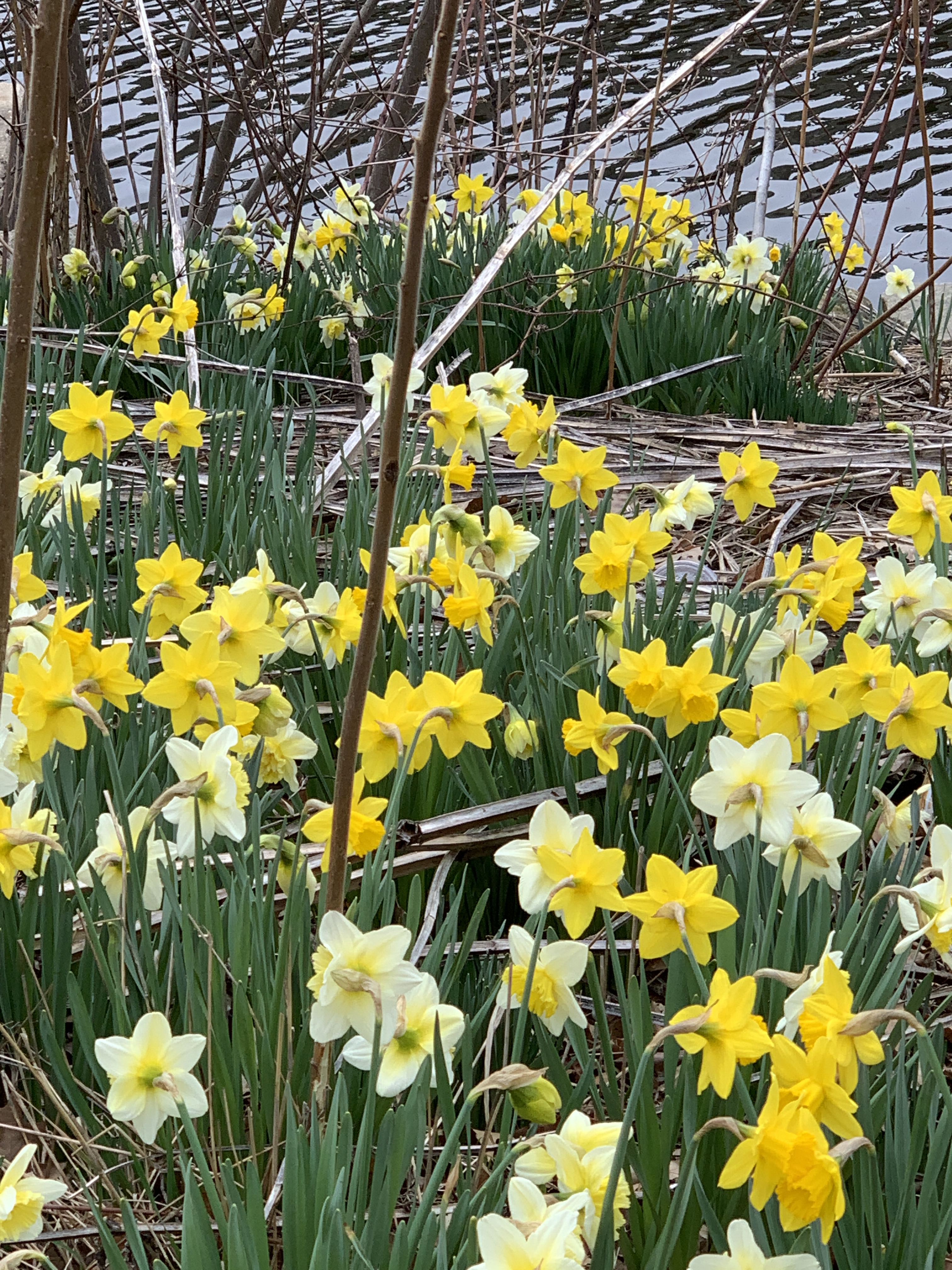
spring time daffodils
untouched by Covid-19
dance closely in sun

IMG_4554Written for Haibun Monday at dVerse, the virtual pub for poets where today Kim asks us to use a previous poem we’ve written about ourselves, and from its core, create a haibun: 2 paragraphs of tight prose followed by a haiku with a seasonal mention.
My haibun today is based on my previous poem Solitude and quotes one line from it.

Photo taken on our walk yesterday — keeping “social distance” from others but enjoying the hope spring brings. So many daffodils planted along the banks of the river Charles…so close together. Would that we can all soon embrace our loved ones and walk arm-in-arm again.
To all my readers:  stay safe, stay healthy, stay positive.

Darkness and Light: Beginning Anew

October 19, 2013. We walked across the street from Mass. General Hospital into a new life. My question: Is there always darkness before light? Night skies before the dawn. In utero before light at the end of the birth canal. Sleep before the alarm sounds. Death before new life.

Six minutes minus a heart beat. Thirty-six hours of induced comatose state. You suspended somewhere; eyes shut, machines whirring. Me existing in light which felt like the darkest of times.

You returned to us and the morning sun. Five days later, we walked home. Six years later, we are together still. Thankful for every day.

dark in chrysalis
strength builds, body renewing
life’s splendor springs forth

Written for dVerse, the virtual pub for poets. Bjorn is hosting Haibun Monday and asks us to write about new beginnings. Haibun: 2 to 3 tight paragraphs of prose (must be true) followed by a haiku. The condominium building we live in is actually located directly across from the main campus of Massachusetts General Hospital.

A Cry for Peace

On a typical hot, humid summer day in Washington DC, we visited the National Air and Space Museum.  A favorite tourist stop for young families, there were many squeals of delight and loads of loud chatter around the space capsules and astronaut exhibits. Parents eagerly read placards aloud and answered their children’s questions.

And then we saw the Enola Gay.  Why does that old plane have that name? Because the pilot, Colonel Paul Tibbets, named it after his mother. Why is it here? Is it famous? How do you answer those questions from a four year old who has no idea where Hiroshima is, what it signifies, and stumbles to even pronounce the word?

decomposing raven
lies outside rotting in snow –
infant wails for breast

Col_Paul_W._Tibbets_before_takeoff_6_August_1945

Frank Tassone hosts Haibun Monday at dVerse, the virtual pub for poets. He reminds us that today is Hiroshima Day 2018. It will be marked by the annual Peace Memorial Ceremony where approximately 50,000 local citizens and visitors, as well as ambassadors and dignitaries from around 70 countries, will] gather in Hiroshima to console the spirits of those killed by the atomic bomb and also to pray for lasting world peace. Our haibun should somehow deal with this theme.

Haibun: Two tight paragraphs of prose, must be true, cannot be fiction; followed by a haiku. I’ve chosen to write a traditional haiku: three lines: 5-7-5 or short-long-short in syllabic form; about nature; includes a Kigo (reference to a season) and a Kireji (a cut achieved by a hyphen, ellipsis, or punctuation mark, that shifts to an added insight within the haiku). 

Photo: Colonel Paul Tibbets before take-off on August 6, 1945. Taken by US Air Force employee (unnamed) – https://www.archives.gov/research/ww2/photos/ photo #162, Public Domain, https://commons.wikimedia.org/w/index.php?curid=9162980