Mother named me Lillian her mother’s namesake. My father’s twin sister’s moniker as well, much to my mother’s chagrin. She chose the middle name of Mae after a favorite aunt, the likes of who I don’t recall. But because of her, twelve cousins called me Lilly Mae. To everyone else, I was Lillian
The momentous moment of change came when my parents left me on my own to begin my college days. First person I met on that idyllic campus, I announced my name as Lill and that’s who I became. Years later, titles attached themselves. Mrs. Hallberg, high school teacher. Dr. Hallberg, the PhD kind. Dean Hallberg, career topper.
Now rejuvenated (never say retired) I’m happily back to Lill. Except when I’m lillian-the-home-poet. Capitalization not preferred because after all, it’s just me.
NAPOWRIMO Day 21. Prompt:Write a poem in which you muse on your name and nicknames you’ve been given.
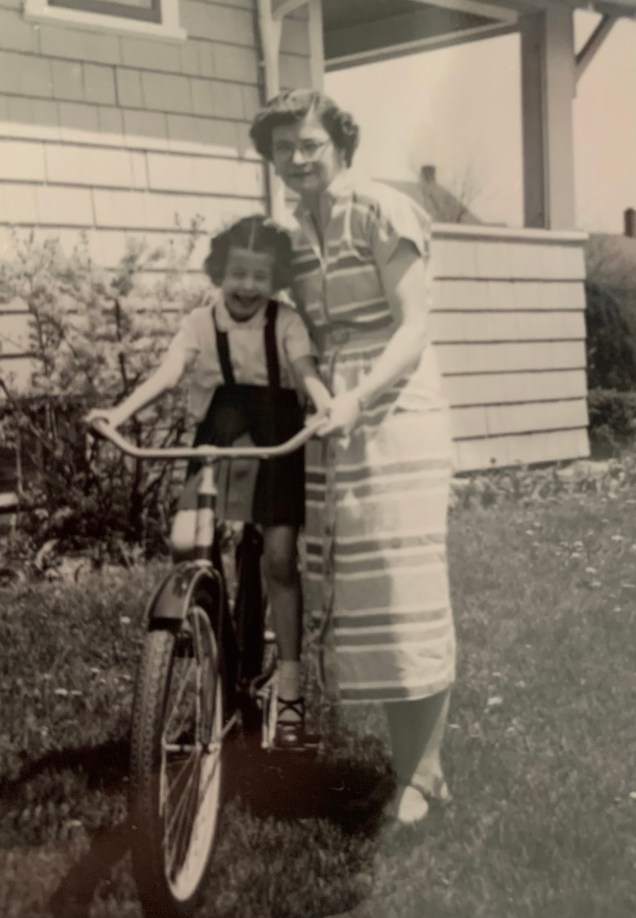
PHOTO of my mother and I and my new two-wheeler bicycle. From tricycle to this. In the 1950s, either they didn’t have small bikes or “training wheels” for kids to learn on or else my folks could only afford to buy me one “big girl’s bike”. One distinct memory I have of my childhood is my dad hanging on to the back of this bike, running along on the sidewalk while I was trying to balance, feeling like I was flying and then looking back and seeing him half-way down the block behind me! I don’t recall if I immediately fell or not….I just remember that feeling and then seeing him so far away, realizing I was riding on my own!
Family of four, both mother, father gone now. Their love still lives on in the way their children love. Circle of love unending.
A Tanka written for Tuesday Poetics atdVerse, the virtual pub for poets around the globe. Kim asks us to write a poem using the title Where Does Love Go and answer the question within the poem.
“He went to sea in a thimble of poetry.” Opening line in the poem Poet Warning, by Jim Harrison.
Wynken, Blyken and Nod my childhood friends, lived in the well-turned pages of mother’s Child Craft Poetry Book. So many friends who made me smile. The Old Lady who lived in a shoe, Miss Muffet sitting primly on her tuffet, Old King Cole and Jack Sprat too.
We laughed about the crazy cow who jumped over the moon. I lived in those pages then, where no one yelled at anyone. Sitting on mother’s lap I’d hug my yellow teddy-bear smeared with mother’s lipstick, so at least, it always smiled at me.
When mama took out that book I knew she’d take me to magical places. And for those moments her love for me was real and clear. So calm, so comforting, so warm, so fun, so motherly, in those make-believe lands.
And here I am, decades later near to being an octogenarian, wondering why I write poetry. I’d forgotten this side of her, so many other memories crowding in. I live by the words, “no regrets” always have and always will. So I am thankful to remember this other side of who she was.
NAPOWRIMO Day 12. Prompt:Write a poem that recounts a memory of a beloved relative and something they did that echoes through your thoughts today.
Image from an illustration in the book, which I still have. Published in 1947, the year I was born.
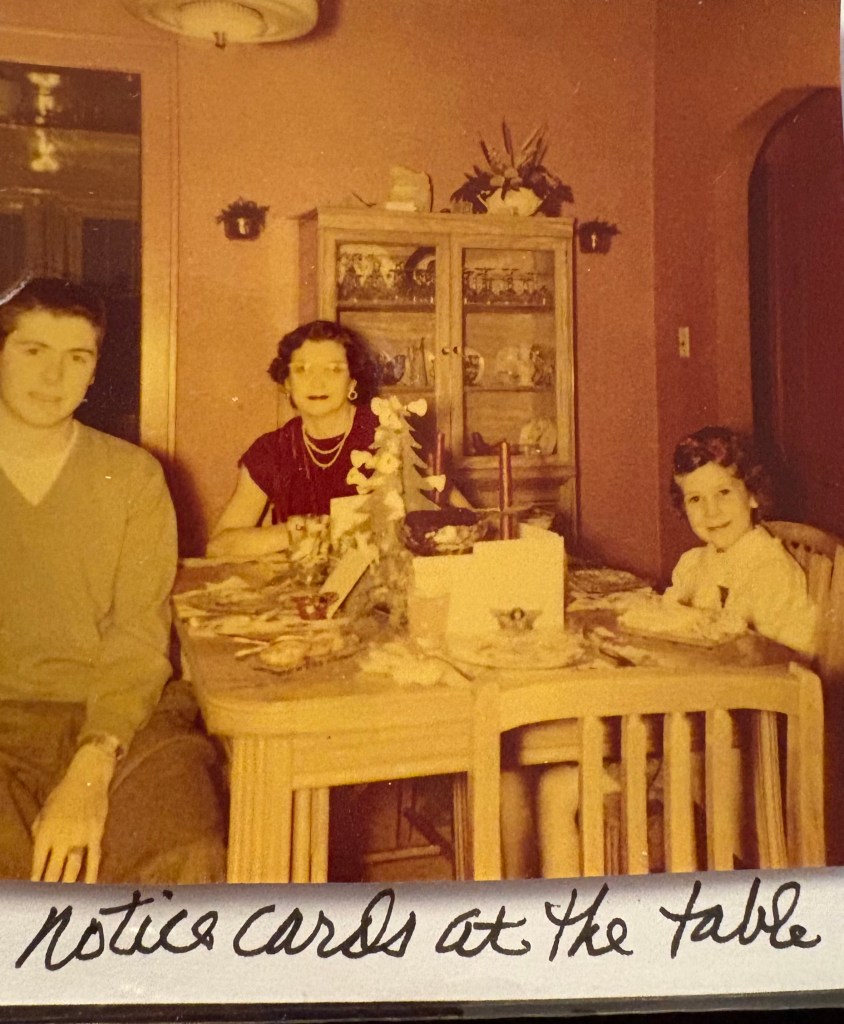
. . . our December twenty-fourth dinners with Alice’s jello salad and pineapple-coconut bars. Rather than bowing our heads and saying grace, we shared cards at the table. One for my mother, dad and brother. And theirs to me.
Raising our family, the tradition continued. Handwritten notes inside meant the most. Some just covered with Xs and Os, some with a memory from that year. Always a personalized declaration of love.
Alice’s recipe is long forgotten. But miles away, with children of their own, our children still live the card tradition. Now, almost in our octogenarian years, we still smile knowingly on those nights as we reach for the personalized card on our plate.
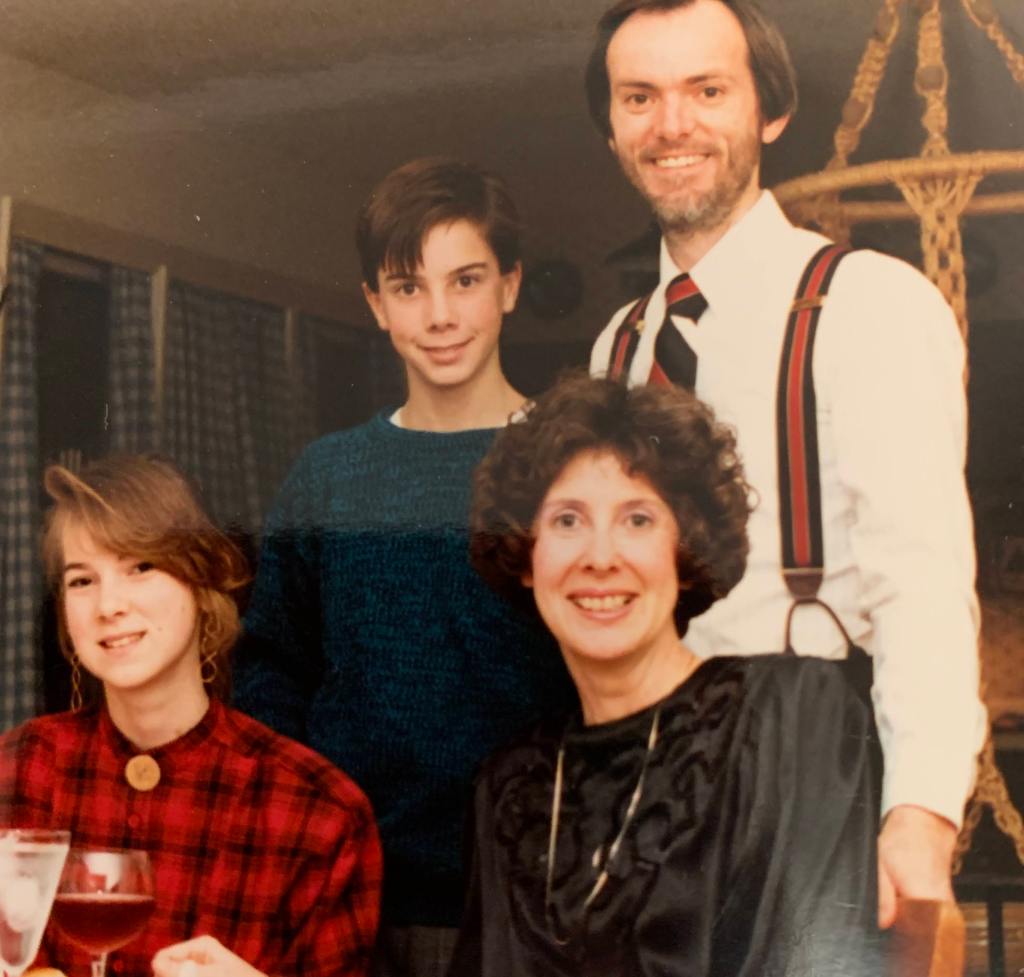
It’s NAPOWRIMO (National Poetry Writing Month) day 2! Today we’re asked to “write your own poem in which you recount a childhood memory. Try to incorporate a sense of how that experience indicated to you, even then, something about the person you’d grow up to be.” Photo from an old photo album…note the writing at the bottom of the photo. Yep, that’s me with my brother (9 years older than me) and my mother.
From the time our children were two and four, we’ve held hands before our evening meal and sung a song called The Circle of Love. With a simple and happy tune, the words go like this:
“The circle of love goes around and round the circle of love goes around. Reach out your hands someone needs you. The circle of love goes around. Amen.”
It’s not by others’ standards, a real table grace. Grace is often defined as the free, unmerited favor and love of God toward humanity. And a short prayer before a meal is often called “saying grace”. For us, this singing together before supper was and always is a moment to celebrate family. Smiling at each other, sometimes grinning, we sing loudly and with energy. What we’re really singing about is the unconditional love and happiness we share. No matter the food – from cheesey chicken casserole to shrimp scampi to Thanksgiving turkey, The Circle of Love was always the first course of the meal.
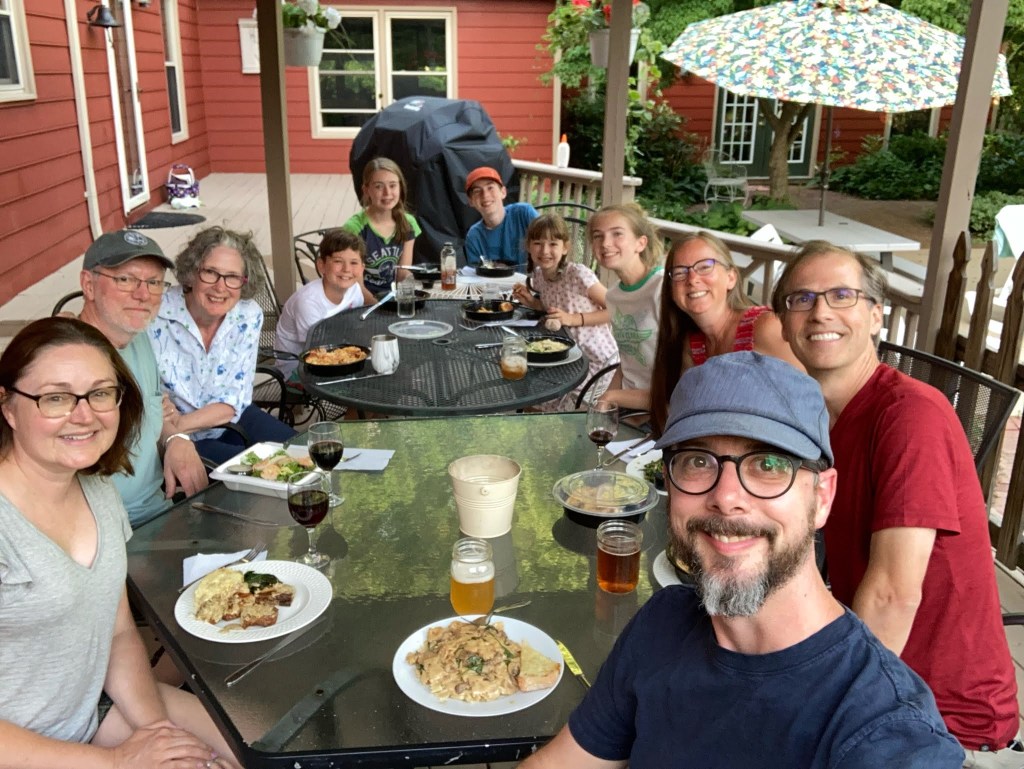
Now, approaching our octogenarian years, with five grandchildren who are twenty, eighteen, and fifteen, and our children and their wonderful spouses in their fifties, we treasure the rare times we are all together. The eleven of us, or a fewer number on occasions when busy lives and miles intervene, still carry on this tradition. When we come to the table for an evening meal, no matter the happenings of the day, the first thing we do is join hands. And then we sing, loud and clear. Grateful for each other and for the meal we share.
Wild flowers in fields different shapes, sizes, colors always face the sun.
Written for dVerse, the virtual pub for poets around the globe. Today Punam is hosting Tuesday Poetics presenting us with the following prompt: “For today’s Poetics, I would love a presence of food in your poems. You can employ any form but touch upon food; vegetables, fruits, meat, dairy, desserts you love or hate. It could be about why you love/abhor cooking/baking, your most memorable/miserable meal ever, your relationship with food…the possibilities are endless.” No particular form or length is required. A Haibun is a Japanese poetic form that combines prose with a haiku. I guess you could say I’ve written about my family’s relaionship with the evening meal!
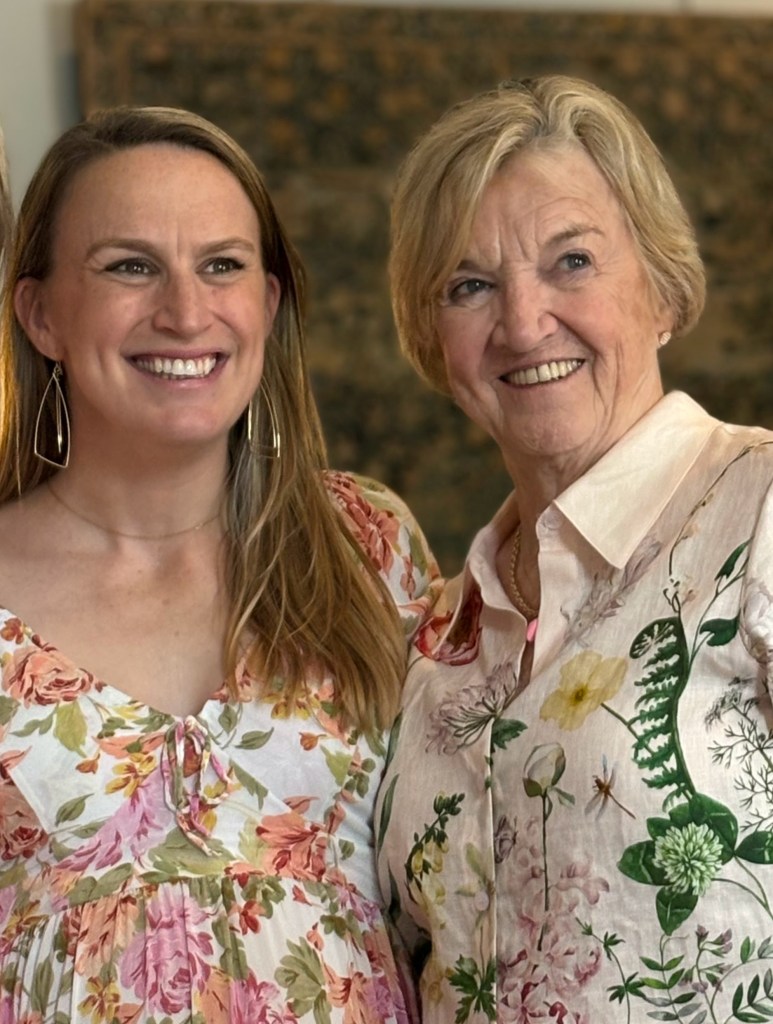
Photo is from a family gathering about six years ago.
Teaching skills. Helping. Watching. Too soon the dividing line appeared, between the now and what was coming.
Responsibilities increased. Yours not ours. Your departures, more frequent, measured at first in hours, not miles.
Your wings. Expected, prepared for. We marveled and smiled. Waved at you . . . and then you were gone.
Distance multiplied. Time stretched separations. Hairline fractures of the heart, smiling our love through goodbyes.
Parenting children to adulthood. Learning to live through changing times, adjusting to the moving margins.
Written for dVerse, the virtual pub for poets around the globe. Today Dora asks us to write about a poem that somehow talks about margins. She gives many examples of margins. As a septuagenarian with two happily married children and five grandchildren, I thought about living through moving margins as a parent and thus, this poem.
Praises to the table, the one our family gathered round. You held court with meals, never minded spilled morsels. Gained rings in the process from sloppy milk glasses.
You listened without judgement. Heard the hijinks of Mrs. Piggle Wiggle, knock-knock jokes, teacher complaints, family disagreements, high school gossip, vacation plans, college choice deliberations, and joyfully sung table graces.
You welcomed guests who crammed in extra chairs. More elbows leaning in, more spills, raucous laughter. Birthday party guests and gangly teens who occasionally kicked your legs.
Now in another house but still in the family, serving another generation. From toddlers punching playdough to kids’ paints slopping on your surface, you still stand proud after all these years.
Written for day 9, NaPoWriMo. The challenge is to write a poem every day in April, which is National Poetry Writing Month.
The NaPoWriMo challenge today, takes a page from the famous poet Pablo Neruda. His poetry, translated to English, is treasured by many. Among his poetry are a series of Odes. An ode is a poem written in praise of a person, place or object. The challenge today? “Write your own ode celebrating an everyday object.”
Photos are of our family table over the years….could not find any when our kids were infants or toddlers. We sure celebrated many a birthday at this table! The table has been at our daughter’s home since her children were very young. They grew up at the same table their mama and uncle did. Last two photos are of our daughter’s and son’s children sitting at the table in more recent years.
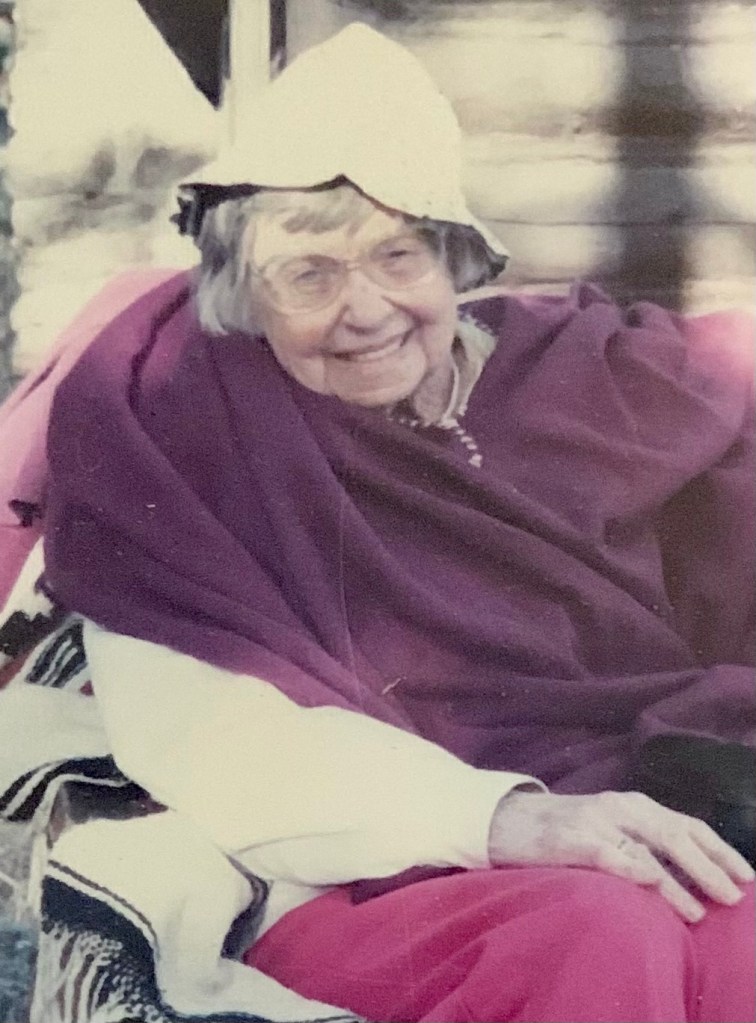
One of four children, her parents died before the age of sixty from massive heart attacks. Her two sisters did the same; as did her brother. She buried her youngest sister on her own birthday and did the same with her only son, who died at fifty-one, also from a heart attack. Her husband died at seventy-three, from complications following open heart surgery. She defied familial medical history and lived to eighty-one, her own heart having been broken many times. She was my mother.
When they called, I rushed to her side. Congestive heart failure finally took its toll. “We’d like to operate,” the doctor said. She quietly shook her head. “I’m so tired, Lillian.” I held her hand and she smiled. But that smile was the last smile to come upon her face. I whispered, “Go and find dad, mom.” And she did.
Written for Prosery Monday at dVerse, the virtual pub for poets around the globe. Today Lisa asks us to use the line, “But that smile was the last smile to come upon her face” in a piece of prose, no more than 144 words in length, sans title. The line is from the poem Ballad of Birmingham, written in 1968 by Dudley Randall. My mother, Helen Cecile Petitclair Gruenwald died in 1998. I had the privilege of being at her side as she transitioned to another world. I remember it clearly.