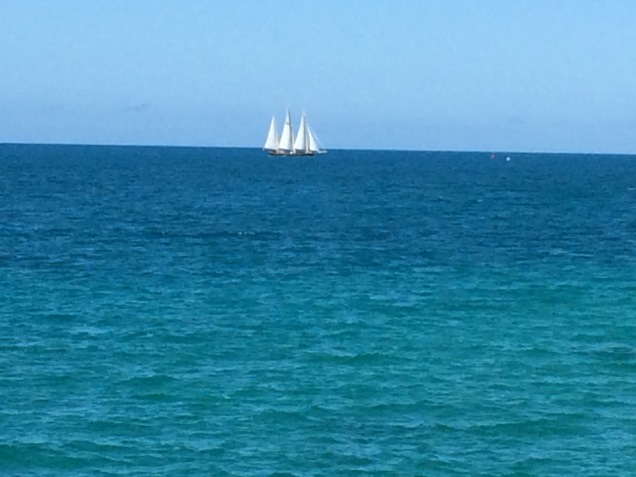
Oh Provincetown!

Gulls squawk, shout high pitched squeals,
breaking through the silent calm of early morn.
Waters so still at low tide, there is no lap
as sun glistened ripples lie mute in their beauty.
Are these the sounds of long past voices
altered by time, soaring above your land?

Norman Mailer, Tennessee Williams, Eugene O’Neill.
Were their bare feet marred by these rock pebbles,
these shards of shell beneath my feet,
tumbled through years of artistic waves?
Indigo waters turn cobalt blue, ombré into sky.
Like one canvas piled upon another,
easels left for another day.

Muse to Jackson Pollack, Jack Kerouac,
Tony Kushner and Kurt Vonnegut.
Given voice by the calm and eloquent words
writ by Mary Oliver, resident of these dunes,
this town at the very tip of Cape Cod,
crooked arm of land surrounded by sea.

Leave the ocean and stroll into her streets.
See bawdy painted lips and swinging narrow hips,
drag queens, moving costumed forms,
tourists, gawkers, art and food afficionados,
hawkers outside beaded doors. Lovers of every kind.
hold hands, strut, saunter, smile and banter.
Sixty-thousand revelers by summer’s tides
ebbs to three-thousand in quiet snow encrusted streets,
appreciate winter palettes of whites and greys.

Oh Provincetown! Town of complexities.
Pilgrims’ pride rejected, settled by Portuguese fishermen
and wives who waited for their return from sea.
So many have claimed you.
So many have walked your streets,
marveled at your cinnabar setting suns,
danced on your sands of time.
And still you offer more.
More palettes of dawn and dusk.
More ocean tides and raucous waves.
More low tides that reveal your under life.
I revel to return again and again.
You hath cast your spell on me.

Written for dVerse, the virtual pub for poets where today, I am hosting and asking folks to write a “travelogue” poem. Take us somewhere! Pub opens at 3 PM Boston (eastern) time. Provincetown is located at the extreme tip of Cape Cod in Massachusetts. In November 1620, pilgrims on the Mayflower landed in the west end of Provincetown and wrote the Mayflower Compact there, before journeying on and settling across the bay in Plymouth. The Governor of the Plymouth Colony purchased the land of Provincetown in 1654 from the Chief of the Nausets for 2 brass kettles, 6 coats, 12 hoes, 12 axes, 12 knives and a box (see wikipedia). Provincetown has been the summer home for many fringe and reknowned artists and writers. Twenty-seven year old Eugene O’Neill produced his first play here in 1916 and spent the next nine years of his life in Ptown.

Moonlight

Daytime, meandering through the Peabody Essex Museum. I stopped to stand and look at a painting on the wall. The looking turned to gazing. Time shifted and everything disappeared. I was under the stars, the shifting clouds. Felt night’s cool air upon my face. Marveled at the moon’s path upon glistening sea. This magical night enveloped me. There was no one else. Nowhere else. Until a tap upon my shoulder made me turn my head.

luminous moon
reflects beauty in darkened sea
neath star spattered sky

img_5072

Double posting today! (see also Wishful Thinking) Written for dVerse haibun Monday where Toni, the maven of haibuns, asks us to write about the night sky. A haibun consists of a short, concise paragraph of prose that cannot be fiction, followed by a haiku. PHOTO taken at the Peabody Essex Museum in Salem, MA:  Moonlight, created in 1892, oil on canvas. Painted by impressionist Childe Hassam (1859 – 1935). The scene is from Appledore Island, the largest of the Isles of Shoals off the coast of New Hampshire, where he spent many a summer at the cottage of Celia Thaxter. 

Tanka for dVerse

waves crash in full tide
rush starts at epicenter
full moon excitement
night’s passion touched rekindled
we lie in sweet exhaustion

Toni hosts the bar at dVerse today (bar opens at 3 PM) and asks us to write a Tanka, a Japanese form of poetry comprised of five lines with the following syllabic count: 5-7-5-7-7. This form is older than the haiku, first appearing in the 8th century!  There is no punctuation, no capitalization, and no title. Third line is a cutting or pivot line. The first two lines examine an image and the final two lines are a personal response. Tankas were considered a “female” form, written more by females than males and were often sensuous. Photos from Bermuda.

Night Time Nostalgia

nights etched in mind
black water glistens
harbor lights beam on sea
shadow figures lean toward wind
far away music starts and stalls
tree frogs serenade the stars
stars peek from black sky
Bermuda’s scrim of night

IMG_3967

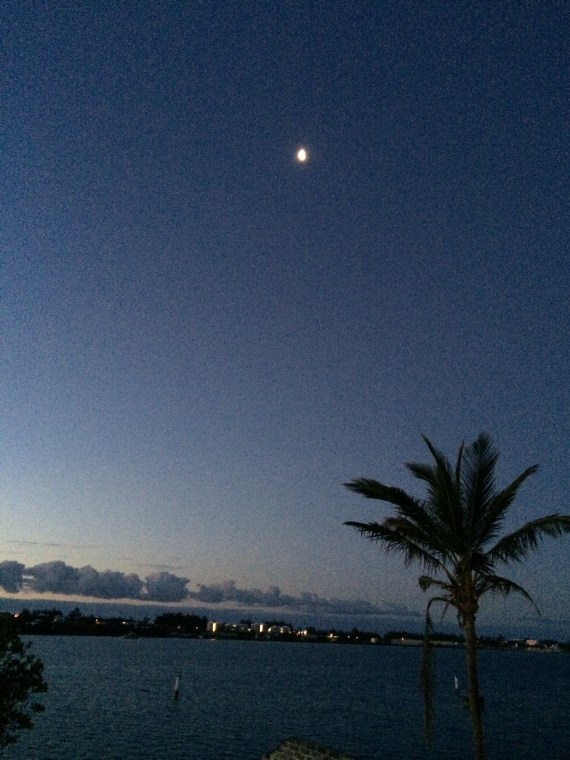
Photo from our deck in Bermuda, just before the stars came out in force….in February. We were right on the harbor….so many beautiful evenings!  Prompt is from my recent June class — write a poem of nostalgia.

Bermudiana Morn

I awake at dawn to sit outside,
watch darkness turn to light,
listen to the fantasia
composed by friends of flight.

Gulls screech, black birds caw,
blend in loud cacophony.
Yellow kiskadees sing their name
kiss-kah-dee atop palmetto tree.

Whistle woo, ee-ooh ee-oohs,
stutter sounds that stop and start.
Nature’s composition,
her ode to sunrise joy.

Sparrows peep and chirp beside me,
ruffle flutter wings then flee
startled by my scratching pen
scoring sounds of brightness in the morn.

Sun warms as notes begin to simmer
overture slowly ends.
Curtain rises on blue skies,
a new Bermuda day.

Thrilled to be guest-hosting dVerse Poetics today! Loving all things fantastical, my poem today uses “fantasia” as it relates to a musical free flow composition. Video from our deck in Bermuda, listening to the dawn. You’ll hear the Kiskadee (yellow bird) quite plainly. And this is one of my many feathered friends who came often to sit with me. Also applying to  NaPoWriMo Day 12.

Bermuda in Style

Rain pelts, lightning tiara,
emerald green limbs
drip gold loquat jewels,
sapphire seas belt her girth.
Bermuda, dark and stormy,
wears her weather well.

Various storm brewing photos and their aftermath in Bermuda over the past two months. Yes: the water is really that colorful!!  No photoshopping done. Poem offered for NaPoWriMo Day 3 (without prompt). The loquat is a delicious fruit that grows on a tree and is ripe when golden. The Dark ‘n Stormy is also the national drink (made with Goslings Black Seal Rum and Ginger Beer).

Lovers

Sun slips into sea
tinging waters pink
as first love’s blush.

Their love, sowed and tilled
through leaving tears,
rekindled in this place

where sky melts blue
into waves of aquamarine.
Bodies meld familiar

then spark as old wick
stammers then flames,
passion reborn.

IMG_4059

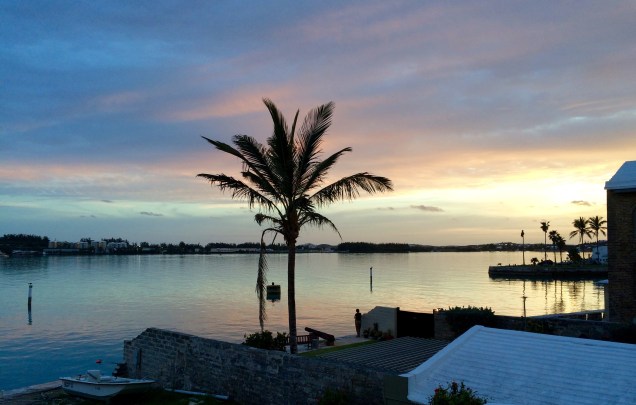
Quadrille (44 word poem) using the word “melt” as prompted by Grace, tending the bar at dVerse, a poet’s virtual pub.  Photo: sunset from our deck in Bermuda.

Ship’s Log

Asail for Jamestown, weather struck an evil chord.
Young ones lashed to timbers, screamed in terror.
Women, hands clasped, lay flat rolling with the pitch
prayers heard by gales of wind, sent from hell.

What reef was that below? That jarring impact?
Yesterday’s aquamarine, myriad shades of blue
now boiling black sea wall, impossible to climb
sails reduced to shreds, precious cargo lost.

Legs like spindles flailed in white caps
wide-eyed heads and struggling arms schooled
instinctively to shore, collapsed on sand
knowing not this somewhere land.

Awake at dawn, miraculously all ashore
but up and down the sands, bits of her, everywhere.
She is beyond sail. But we are not.
We are a hearty group, this the royals knew.

There are no Others here. No conversions
or wars divert our attention. We live
amongst fowl and fish of many shapes
and harvest abundant cedar trees.

Birds, unused to four limbed walker-talls,
never learned to fear. And so we pet and grab
and spit, until their raucous calls, cahow cahow,
forshadow their impending doom.

We are users now, building for tomorrow.
Tall cedar limbs bend and crack as they grow less
our hopes grow more. The sails shall rise
and we shall once again, ride atop these seas.

1610 ~
The time has finally come. Farewell this land
your gifts to us immeasurable.
And I wonder as I write, who next
shall see this beautiful isle
beneath the skies that never end.

IMG_0760IMG_0840IMG_3431

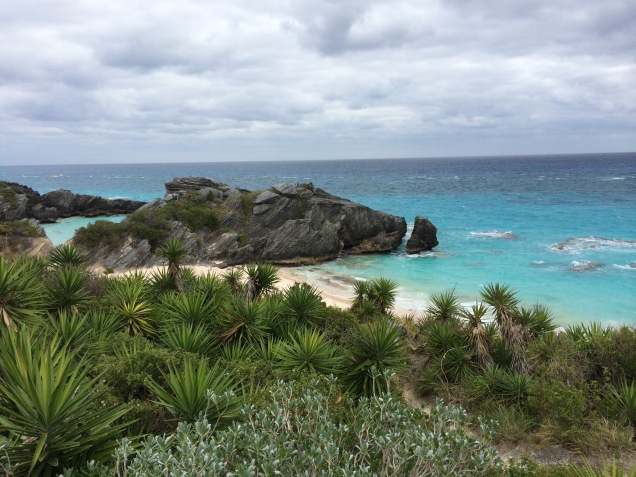
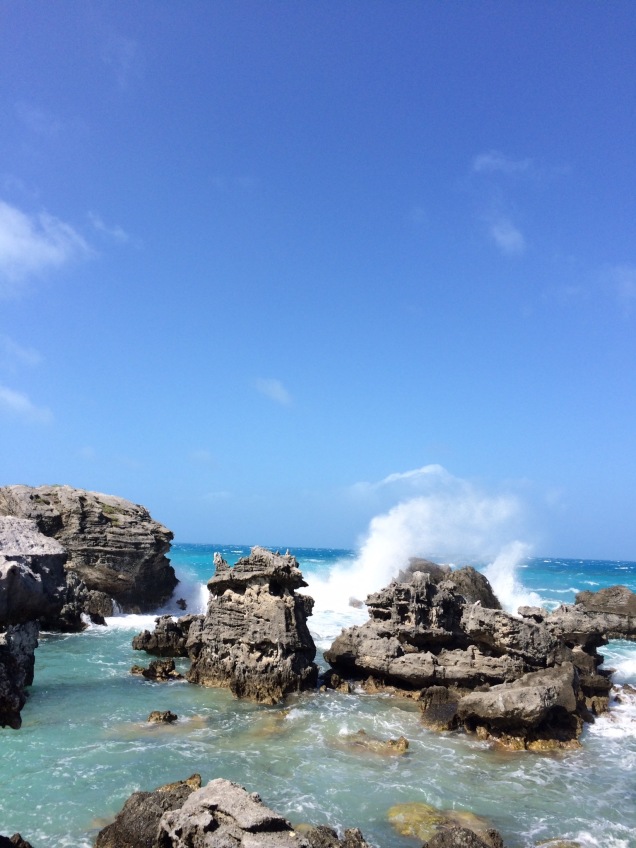
Photos from Bermuda — the myriad shades of blue!  Written for dVerse..Kelly tending bar at dVerse asked us to write a narrative poem, somehow including a bird — in commemoration of Harper Lee’s recent death, author of To Kill A Mockingbird.  This is (with some liberty) the story of Bermuda’s discovery — totally by accident. The island was uninhabited when discovered. Sadly, the cedar timbers once so plentiful, are all but gone. And the Cahow, once thought extinct, is now making a comeback with help from naturalists here.

What Death Lies Here

The tall waving grasses are always green
in this blessed and hallowed place.
Tombstones crumble, long passed souls embrace
‘neath palmetto fronds, while angels pray unseen.

And one lone cherub, an alabaster figurine
guards still the lad beneath her, quiet in grace.
The tall waving grasses are always green
in this blessed and hallowed place.

The sea nearby crashes waves of aquamarine,
spews salted grits of sand through air to stone efface.
Sacred words, names and years, all but erased
yet bones and dust beneath, feed this earth serene
the tall waving grasses are always green.

Gayle, in dVerse, asked us to create a Rondel: 3 verses (2 quatrains and a quintet). It must have a refrain: Lines 1 & 2 are repeated in lines 7 & 8; and line 1 must also be line 13.  The rhyme scheme must be ABBA   ABthen-line-1-and-line-2   ABBAthen-line-1.  The challenge is to have the form “disappear” within the meaning of the poem.  Photos: from our walk yesterday which included meandering through St. Peter’s cemetery, established in 1854, located atop a hill in St. George’s Bermuda.