Earth’s breath,
whisper wind
hissing gushing geysers
howling gusts
quiet sighs.
She breathes as her children live.
Inspired by recent dVerse prompt to write about breath. Photos: Tauranga NZ on the farm used for Hobbiton in Lord of the Rings; Rotorua, NZ — geysers on land of the Maori people; untitled painting by Louise Hearman, Australian artist, exhibited at the Art Museum of New South Wales — all her paintings are untitled; and Lake Wakatipu near Queenstown, NZ. All taken on our recent 40 day journey to Singapore, Bali, Australia and New Zealand. I have now returned and shall be posting regularly again. Hope you’ll join me often — I enjoy the feedback of readers!
Clouds slung over land
like a prayer shawl before the dawn.
They cling softly to earth’s shoulders,
until sun begins to warm her soul.
Mist slowly slips away
leaves moisture upon her limbs,
like tear drops shed in supplication
seeking grace for this day.
Monday’s quadrille (a poem of exactly 44 words) for dVerse, that virtual pub for poets, where today Kim is tending bar and folks are writing about clouds. Bar opens at 3 PM Boston time. Stop on over and imbibe in more clouds. Photos from a past trip to Alaska.
Artists stand behind easels before the sea,
subject sits beneath natural canopy.
Sun reflects off sand,
reveals delicate hollow at nape of neck.
Streaming light illuminates hair by strands
as shadows gleam, challenge brushes
to blend raw umber, titanium white,
and yellow ochre oils.
Written for dVerse where today De is tending bar, asking us to write a quadrille (poem of 44 words; no more, no less) relating to or using the word “shadow.” Last week in Provincetown, I volunteered to sit for a portrait session on the beach. Little did I know these were students of Cedric Egeli, one of America’s foremost portrait artists. The second photo shows him critiquing his students. Plein air refers to painting out doors.
Daytime, meandering through the Peabody Essex Museum. I stopped to stand and look at a painting on the wall. The looking turned to gazing. Time shifted and everything disappeared. I was under the stars, the shifting clouds. Felt night’s cool air upon my face. Marveled at the moon’s path upon glistening sea. This magical night enveloped me. There was no one else. Nowhere else. Until a tap upon my shoulder made me turn my head.
luminous moon
reflects beauty in darkened sea
neath star spattered sky
Double posting today! (see also Wishful Thinking) Written for dVerse haibun Monday where Toni, the maven of haibuns, asks us to write about the night sky. A haibun consists of a short, concise paragraph of prose that cannot be fiction, followed by a haiku. PHOTO taken at the Peabody Essex Museum in Salem, MA: Moonlight, created in 1892, oil on canvas. Painted by impressionist Childe Hassam (1859 – 1935). The scene is from Appledore Island, the largest of the Isles of Shoals off the coast of New Hampshire, where he spent many a summer at the cottage of Celia Thaxter.
I ran outside that night,
so full of life and excitement.
Imagined your surprise and thought I would see
a grimace,
a crease,
a worried frown.
Someone finally broke through.
Landed. Slammed into you
and stepped into your heart.
Your cold, aloof self,
finally
breached.
And yet I saw nothing new.
Your face unchanged,
seeing me only
as one of many who adore you,
who live and stare each night
beneath your remote reserve.
Thirty-plus years have passed.
I arise more slowly to morning sun,
less sure of my footing,
skin aged and sallow.
I still await the end of day
to feel your face upon my soul.
I peer through clouds within my eyes
and those that skirt your skies.
For I have loved you all these years
even as you appear
and disappear
and appear again.
You my love, care not.
You seem to ignore what I crave.
All I seek these many nights
is some recognition,
some sign,
that we have been with you.
Full moon over Provincetown. Cape Cod, MA.
Written for Tuesday Poetics at dVerse where Grace asks us to write about the moon as if the moon is a person – flesh, sweat and blood. “Describe him or her, and tell us about your moon.”
On July 20, 1969, I was 22, a graduate student at Bradley University in Peoria, Illinois. I’d heard about “the man in the moon” since I was a young child. You can “see” his face in the full moon, made by shadows and craters visible to the naked eye. On that July night at 9:56 PM, I watched my tiny portable television screen as Neil Armstrong stepped onto the surface of the moon. I remember staring in awe and then immediately running outside, standing on the sidewalk and looking up at the moon, as if I could see some sign up there! And I remember thinking: tonight there really is a “man in the moon.” Dverse opens at 3PM EST. Come join us!
Sunflowers
pivot eager brown faces
toward the sun
and turn away at dusk.
Nature’s solar sensors.
Photo taken in Provincetown, Cape Cod. A tanka is a 5 line poem with the following linear form: short,long,short,long,long. Sometimes it follows this syllabic form: 5,7,5,7,7.
Natural beauty, serene
sits in aura of pine tree wisps.
Feathered creature.
Brown, taupe,
shades of ebony and white.
Round face pivots not.
Stoic eyes stare
as voyeur camera
takes its shot.
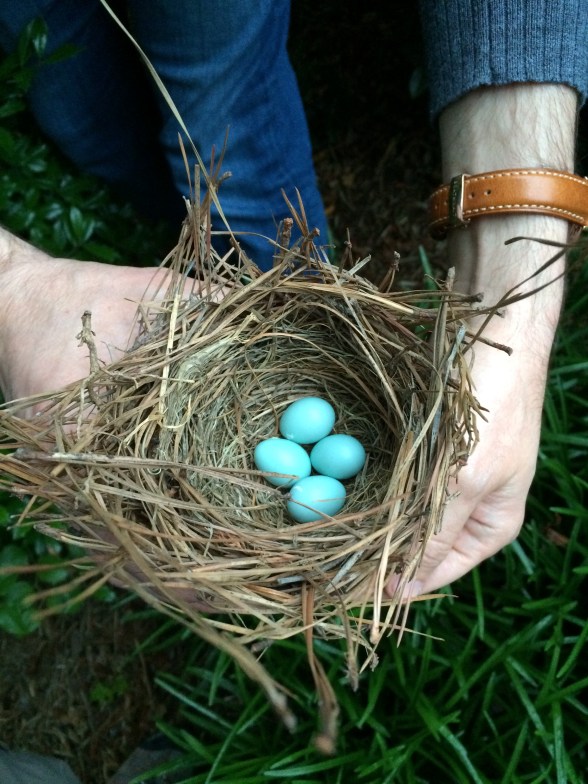
Amazing photo taken by my niece, Charli Michele Gruenwald, in her back yard. She lives on Lopez Island in the state of Washington.
Who made this day?
This longest day in the journey.
Scarf thrown off, head tilted back,
away from ticking hands.
No clocks in sight.
More time to revel in the sun.
And she shall do a walk about.
About the bird who places one more
blade of new mown grass upon her nest
and then another and another still.
About time that cannot stop,
but will elongate,
prolong the light on this day,
a broader spectrum in which to heal.
She sees you seeing her.
Watch longer. Hold tighter.
Her body whole, a holy place,
where prayers of so many reside
and battles will be won.
Walk about this longest day,
savor life and love.
Dedicated to my friend, Louise.
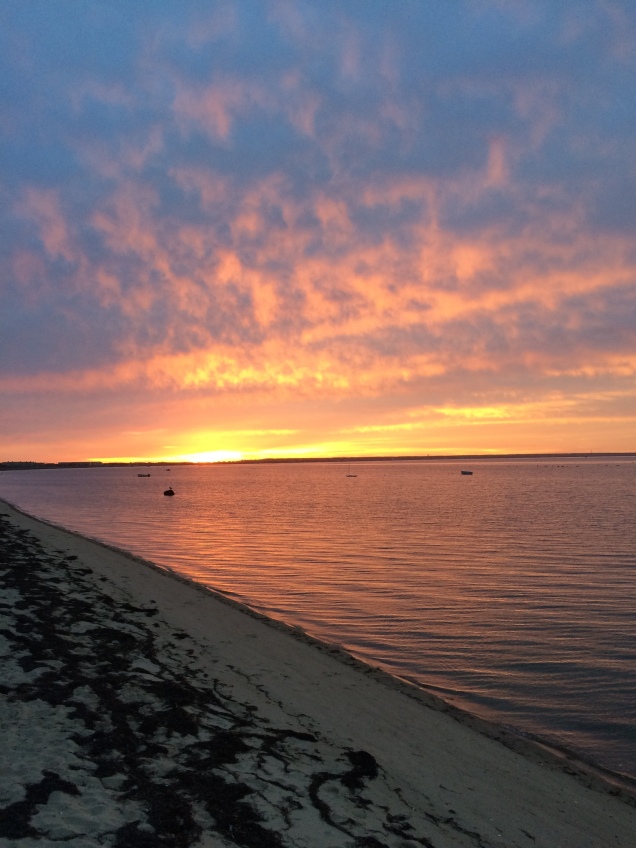
Walter is hosting Tuesday’s Poetics at dVerse and asks us to consider the Summer Solstice, perhaps beginning with the idea of another poet. I looked to Mary Oliver’s The Summer Day which begins, “Who made the world?” Photo from Cape Cod — sun rise —
Cornfields, stalks of silk-tasselled green planted in marching rows, wave in hot humid breeze. Then slowly stop. Stand tall. Sensing. Waiting. Sky shifts from grey to sickly yellow. As if the early morning sun has returned to sulk and leave its stain. A rushing sound begins to fill the air. Decibels increase as dark clouds coalesce. Meld into a funnel shape and roar across the field. Dust swirls up from roads, their surface shocked as rain explodes from sky.
Field mice hide
‘neath towering stalks of grain and corn
as sky erupts in fury.
Written for Haibun Monday at dVerse, the virtual pub for poets. Toni tending bar talks about the Japanese culture – in particular, fifty shades of rain. There are 50+ words for rain. She asks us to use one of these words in the title or the body of the haibun (prose followed by a haiku). The Japanese haiku: 3 lines, short, long, short; always about nature. The Americanization of the haiku has shifted to a strict three line, 5-7-5 syllabic form, about any subject. Shinotsukame means intense rain.




 lillian the home poet