Two Clerihews

** A clerihew is a comical biographic verse. See full explanation below photos.

i.
All the ladies admired the young Houdini,
but wished he performed in a thong bikini.
Their screams take it off created a racket
as he hung upside down in a confining strait jacket.

ii.
Rip Van Winkle slept away the years,
escaped his wife’s nagging and too-often tears.
Thought he’d be a ladie’s man, a new phenomenon,
instead he limped beside the dames, testosterone gone.

Written for dVerse, a poet’s pub, where today Gayle asks us to write a Clerihew: a comic verse on biographical topics consisting of 2 couplets and an aabb rhyme scheme. The first line is to name the individual. Form invented by Edmund Clerihew Bentley (1875-1956) at age sixteen. Very challenging to write humorous poetry!!!  Pub officially opens at 3 PM Boston time…drop by and read some more of these — or try your hand at comical verse and share yours with other dVerse readers!

The Feminist Deconstruction of Humpty Dumpty

I warned you!
and the spiders have taken heed . . .

You cared not to sit with ordinary blokes,
dangled your feet and watched all their woes.
You squirreled me away with Peter’s wife,
stuck in a pumpkin shell for life.

I am not addled nor scrambled in wits.
And so in the evenings of hey diddle diddle
your eyes on the cow and the cat and the fiddle,
I found my way out, maneuvering the vine.

I added more bricks by the light of the moon,
layer by layer, higher it grew.
Til I smiled in the window that final day,
snacking on pumpkin and watching you swoon.

You sat on your wall, looking down upon me
sneering and laughing and kicking in glee.
And then with bravado, a tip of your hat,
you leaned forward and laughed
until . . .

Splat!
All the King’s horses and all the King’s men
couldn’t rewrite you together again.

The wall is demolished, Jill’s bucket is full.
I am quite proud and raucously so,
to sit on my tuffet, secure in my ways,
eating, nay feasting, on curds and whey.

Kim is hosting Tuesday Poetics at dVerse, a virtual pub for poets. Bar opens at 3 PM. We’re asked to take a character, fictional or non-fictional, and re-write their story from the point of view of their husband or wife. I’ve taken the liberty of assuming Little Miss Muffet was married to Humpty Dumpty 🙂  Photos from Childcraft, Volume One Poems of Early Childhood, copyright 1947.  I may be a tad older than my readers so these photos provide the Mother Goose rhymes alluded to in my poem.

Merry Me Not

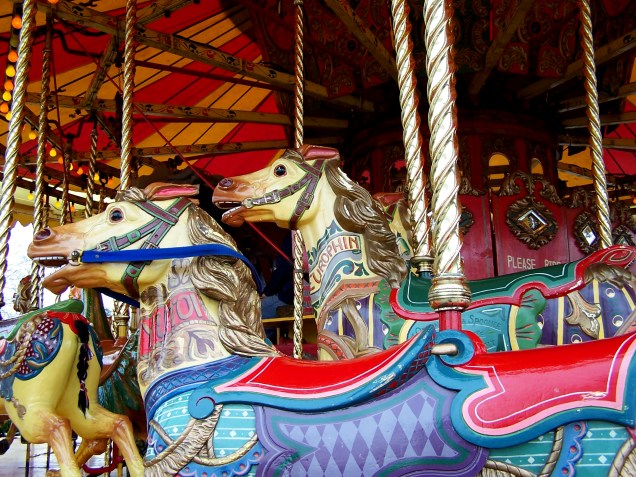
Carnival merry-go-rounds go
round and round and up and down.
My knot-so-merry-tummy goes
round and round and up
and down and urp [sic] it goes,
paint me calliope green.

merry-go-round-horses-2-1442505

Written for dVerse Tuesday Poetics where CC is tending bar. The topic of conversation is “even monkeys fall from trees.”  CC asks us to write about mistakes we’ve made – can be humorous or serious. Well, I learned the hard way — I never ride on merry-go-rounds! Photo credit: Richard Styles

Did you know?

Long before Orwell’s 1984
big brother watching you
drones and satellite stations,
there were pigeons in the sky.
Cameras upon their chests,
they reported fowl news
to those who knew.

Jobs stolen,
usurped by technocrats,
they simply gather now
where cracked corn is tossed.
And when they do take flight,
their only sign of rebellion
is the occasional shit upon your head.

julius_neubronner_with_pigeon_and_camera_1914 449px-dr_julius_neubronner_patented_a_miniature_pigeon_camera_activated_by_a_timing_mechanism_1903 800px-pigeoncameras1

Written in response to Miz Quickly‘s posting of the following article from The Public Domain Review:  Dr Julius Neubronner’s Miniature Pigeon Camera
In 1908 Dr Julius Neubronner patented a miniature pigeon camera activated by a timing mechanism. The invention brought him international notability after he presented it at international expositions in Dresden, Frankfurt and Paris in 1909–1911. Spectators in Dresden could watch the arrival of the camera-equipped carrier pigeons, and the photos were immediately developed and turned into postcards which could be purchased.  Photos from same article.  Hope I gave you a smile with this! 🙂


Cowboys and Me and Junie Z

Junie Z and I,
we had a lot of fun
watchin’ Winky Dink and Me
eatin’ PB and J sandwiches
in front of her black and white tv.

But she liked Gene Autry
that singin’ cowboy,
and Roy Rogers and Dale
croonin’ Happy Trails to You,
like it was just for her.

Me? I was the silent type.
Who would guess it now.
The Lone Ranger was my guy.
No sissy singin’ – just that masked man
ridin’ into those far off hills.

So imagine my surprise
hearin’ good ole Gene
on the radio today
preachin’ at me in song,
There’s no back door to heaven.

And I guess he’d know,
at least in the eyes of Junie Z
after all these years,
but not for tone-deaf me.

Couldn’t resist putting up a more light hearted one for the prompt. Take a listen — ah the childhood memories of me and Junie Z!  Posted for Dverse Tuesday Poetics, a poem somehow related to “doors.”

Party Lines

Telephone chatter,
chirps heard round the neighborhood.

Eunice knows
what clara knows
what maybeth knows
what celia knows.

Biddies gathered round the wire
in times gone by.

grey-day-with-pigeons-roger-bultot

Word Count: 27.  Written for Rochelle Wiseoff-Fields’ Friday Fictioneers (photo prompt appears on Wednesdays)  Photo credit: Roger Bultot.  Apologies to those expecting fiction here….saw this photo and could not resist! When we were first married (early 1970s) we lived in Marengo, Iowa — the last place in the USA to have 4 digit phone numbers (think about that!) and of course, we also had party lines. For those of you too young to understand, those were the days of rotary dial phones where 5 or 6 or sometimes more families all shared the same “line.”  We always picked up our telephone receiver (the piece you listened to and spoke into) carefully, and didn’t start dialing until we knew it was “free.” OR, chuckle deviously here, you could listen in to what was going on in the neighborhood!


Jack and the Beanstalk revisited

Jack Spriggins,
I’m here to settle up.
I took yer cow some days past,
gave you beans to plant in exchange.
You said it’d be a good swap fer me
since I had young’uns to feed.

Well sir, the cow, she turned up dry
and the missus is still howlin’.
Neighbors down the road apiece
talkin’ about an oversized grave.
You buried a giant back here?
Shoveled it deep and high as can be.

I reckon this here’s the hill I’m lookin’ at,
and I can see, it’s paved with gold.
Best make good yer swap, Mr. Spriggins,
and share the wealth you got.
Else I predict yer goose is cooked
and you’ll take a fall from way up there.

And that new wife of yours named Jill?
I reckon she’ll come tumblin’ after.
I learned a long time ago,
stolen goods are not the way
to livin’ happily ever after.

magic_beans

Originally written for NaPoWriMo’s day 21 prompt: a poem in the voice of a “lesser” character within a fairy tale. Rewritten for dVerse Open Link Night, where Victoria is tending bar. dVerse is a virtual pub for poets. Stop by to exchange ideas, post and read wonderful poetry!

EXPLANATION OF POEM: Jack and the Beanstalk is a famous English fairy tale originally written in 1734 as The Story of Jack Spriggins and the Enchanted Bean. Plot: Jack’s cow goes dry. On the way to sell her at market, he meets an old man who trades Jack some “magic beans” for his cow. Jack climbs the resultant beanstalk, finds a castle, a giant, a goose that lays golden eggs and a magic harp. He steals the wealth, is chased by the giant, axes the beanstalk and the giant falls dead to the earth. Jack and his mother live happily ever after.
There is also a reference here to the traditional 18th century English nursery rhyme:
Jack and Jill went up the hill
to fetch a pail of water.
Jack fell down and broke his crown
and Jill came tumbling after.