Ode to Dandelions written in american sentences

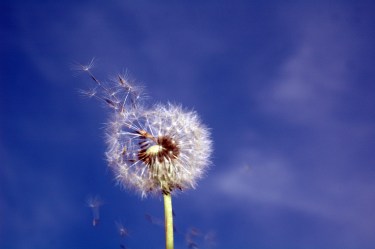
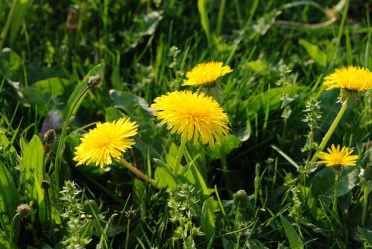
Nature loves the despised, unwanted dandelions, blessing them yellow.

Come dance in refreshing rain, make mudpies and weave wreaths of dandelions.

Summer’s birthday candles: dandelion seed wisps float across wish strewn air.
dandelions-1341698    dandelion-38-1387988

The American Sentence as a poetic form was created by Allen Ginsberg. It was his attempt to make an American haiku. As the Japanese haiku is 17 syllables going down in Japanese text, the American Sentence is 17 syllables going across, linear, like just about everything else in America.

 In a 1991 interview with Thomas Gladysz, Allen Ginsberg was asked about the sacramental nature of life as an aesthetic for his photography. Allen replied: “I think the notion is a Native American art aesthetic and life aesthetic, but my formulation of it is reinforced by a lot of Buddhist training. The notion is basically that the first noble truth most all of us acknowledge, especially senior citizens, is that existence is transitory – life is transitory. We are born and we die. And so this is it! It gives life both a melancholy and a sweet and joyful flavor…Any gesture we make consciously, be it artwork, a love affair, any food we cook, can be done with a kind of awareness of eternity, truthfulness…In portraiture, you have the fleeting moment to capture the image as it passes and before it dissolves…It captures the shadow of the moment.” Italicized is quoted from Paul E. Nelson: About Form: What Are American Sentences.
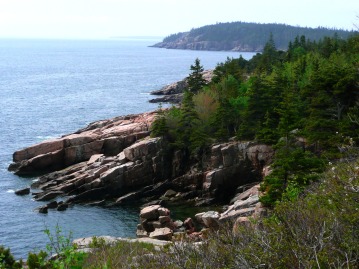
 

Maine

I’d read Blueberries for Sal as a young girl. Robert McCloskey’s 1949 Caldecott winner, set in rugged Maine. And so I recalled that book many years later, spending three glorious days in Acadia National Park.

We spent our indoor time within the cozy confines of a knotty pine cabin. Mornings of hot steaming coffee mugs, looking out windows that opened to the northern woods. Bedtime, covered in faded down quilts, noses chilled as our fire turned to softly glowing embers.

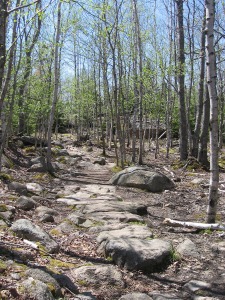
Afternoon walks took us along the coastline, climbing over rock strewn paths with views of crashing waves. Trail number three turned inward, passed ruins of a wall, crumbled stones scattered in wild tall grasses. We walked through a dense birch tree stand. And in one magical moment, the wind whipped up and the canopy of branches swayed. Sunlight streamed in, creating a shimmering lacework overhead.

Our last evening, in denim shirts and hiking boots, we made our way at dusk to the top of Cadillac Mountain. We lie back and watched the sky turn glittering black. Specks of incandescence gleamed light years away. The only sound was our intake of surprised breath as a shooting star streaked from left to right, to another place in time.

sun light dances
through birch tree leaves and disappears
as stars skitter into view

acadia_national_park acadia_national_park_maine_landscape

Written for Haibun Monday at dVerse Poets’ Pub with Bjorn tending the virtual bar, asking us to write a haibun about a walk we’ve taken.  Photos from Acadia National Park, Bar Harbor Maine.

Fini

extinction has become
a way of life
push ‘em back, push ‘em back
way back

thieves in the night
spread into the world
Serengetti, oceans blue
chrysalis and hives

letter writing, long white gloves
walking unplugged and fountain pens
family dinners, darning socks
rotary dial and porch talk

push ’em back, push ’em back
way back

civility disappears in spews
listening usurped abducted
mouths agape without ears
warnings ignored

das Ende, el fin
fine, mwisho

push ’em back, push ’em back
way back
, yeah team

OLYMPUS DIGITAL CAMERA

NaPoWriMo Day 27 — using day 26’s prompt to write a poem with a refrain. Confession: I was a high school cheerleader.  “Push ’em back, push ’em back, way back” was used when the other football team was getting too close to the goal line. That “refrain” popped into my head and then I started thinking about all the things that have disappeared in my lifetime — far too many to mention here. And I realized, extinction has become a way of life — how strange to put those two words together!  “the end” is offered in different languages. It is after all, a worldwide problem. Thought the Japanese word for “the end” was quite interesting, containing the English word “wish.”

…and the bloom shall fade

Her garden suffers from end-of-season neglect. Nutrients wane as days shorten. Young trees, now mature, cast their presence in shadows.  Flower petals and fronds wither to veined brittle frames of their former beauty. They bend closer day by day, to the earth from which they came. Winter’s cold reality approaches, as sure as the moon changes face. Life hovers on a thread.

She sits patiently
window blurred with veins of frost
waits for children gone.

image2

Susan Judd is hosting dVerse for Haibun Monday and provides us with her beautiful photography and the descriptive phrase “beauty in decay” as a prompt for writing today. If you’re not familiar with dVerse, stop in for a visit. It’s a great gathering place for those who enjoy poetry!  Also using for NaPoWriMo day 25.  30 poems in 30 days, that’s April – National Poetry Writing Month.

Bermudiana Morn

I awake at dawn to sit outside,
watch darkness turn to light,
listen to the fantasia
composed by friends of flight.

Gulls screech, black birds caw,
blend in loud cacophony.
Yellow kiskadees sing their name
kiss-kah-dee atop palmetto tree.

Whistle woo, ee-ooh ee-oohs,
stutter sounds that stop and start.
Nature’s composition,
her ode to sunrise joy.

Sparrows peep and chirp beside me,
ruffle flutter wings then flee
startled by my scratching pen
scoring sounds of brightness in the morn.

Sun warms as notes begin to simmer
overture slowly ends.
Curtain rises on blue skies,
a new Bermuda day.

Thrilled to be guest-hosting dVerse Poetics today! Loving all things fantastical, my poem today uses “fantasia” as it relates to a musical free flow composition. Video from our deck in Bermuda, listening to the dawn. You’ll hear the Kiskadee (yellow bird) quite plainly. And this is one of my many feathered friends who came often to sit with me. Also applying to  NaPoWriMo Day 12.

How Long Can We Ignore?

Alaska weeps daily. Generations of ice, layer upon layer, receding.
Our hush, accompanied by the incessant slow drip of her melting tears.
Like a primal scream from self-inflicted wound, the crack of calving
sends shock waves through our cold.

We turn gingerly, hiking sticks in hand, clamp-ons strapped to boots.
Our quiet retreat is nudged by descending mist. A veil to cover her shards.

Earth dies every day.
We stand on the precipice
blind to her needs.

Written for Haibun Monday at dVerse. Prompt is to reach out, write somehow about a silence among us.  Photos from our 2015 trip to Alaska. Chunks of ice as the cruise ship approaches Hubbard Glacier; its shelf looks so small here — in reality it is hugely tall and in the sun, appears as this beautiful color. Other two photos from our 5 mile hike to the toe of Laughton Glacier. The close-up is on the toe, rock debris carried as the glacier slowly moves.  Look closely, about in the middle of the photo, you’ll see the melting. Incessant melting creating glacier streams. We are all too silent, watching the effects of global warming.


Paging Vincent Van Gogh

Hybrid sunflowers
big time flower power.
Fast growing giant Kong,
Bashful Lemon Queen,
bold eye catching.
Ms. Mars, uncommonly gorgeous.
Elf, compact charmer
and Little Becka too.
Madly floriferous Candy,
Strawberry Blonde, Frilly
and Crimson Blaze,
dazzle with sensuous high definition.
Sunny Bunch, Honey Bears
precious beauties,
incredible lovable faces.
All flummoxed on your easel,
sowed one quarter inch deep
in oil, denied full sun,
borders and beds.
Your fame, their demise.

IMG_7325 - Version 2

Written for Day 6 NaPoWriMo, using day five’s prompt: Create a poem using words from a seed catalogue. This is from Burpee’s 2016 catalogue, pages for sunflowers. All words, including title, are exactly as written in Burpee’s except for those italicized. Kong, Bashful, Lemon Queen, Ms. Mars, Elf, Little Becka, Candy, Strawberry Blonde, Frilly, Crimson Blaze, Sunny Bunch, and Honey Bears are all hybrid sunflower varieties. I do love the Found Poetry genre. Photo: from beautiful Cape Cod’s Provincetown, several years ago. 

Fannie Quigley, 1870-1944

Train moved round the bend, civilized now,
not then. Those days, she chose life
off the beaten track. No lookin’ back.
Twenty-six claims staked and panned.
Never hit it rich the way we define it.
Kantishna, home to caribou, moose
and Fannie Quigley. One tough broad.
Slung back whiskey and cussed with ‘em all.
Calloused hands skinned her kill
then rolled flaky pie crust,
bear lard, the secret.
Legendary in her day and beyond,
she took no train but her own.

Written for NaPoWriMo 2016 Day 5 and dVerse Pub for Poets where Bjorn suggests we use the idea of railroad/trains for a poem today. Photo Credits: from our Alaska trip last year. We visited the remote cabin of Fannie Quigley.

Bermuda in Style

Rain pelts, lightning tiara,
emerald green limbs
drip gold loquat jewels,
sapphire seas belt her girth.
Bermuda, dark and stormy,
wears her weather well.

Various storm brewing photos and their aftermath in Bermuda over the past two months. Yes: the water is really that colorful!!  No photoshopping done. Poem offered for NaPoWriMo Day 3 (without prompt). The loquat is a delicious fruit that grows on a tree and is ripe when golden. The Dark ‘n Stormy is also the national drink (made with Goslings Black Seal Rum and Ginger Beer).