Moonlight

Daytime, meandering through the Peabody Essex Museum. I stopped to stand and look at a painting on the wall. The looking turned to gazing. Time shifted and everything disappeared. I was under the stars, the shifting clouds. Felt night’s cool air upon my face. Marveled at the moon’s path upon glistening sea. This magical night enveloped me. There was no one else. Nowhere else. Until a tap upon my shoulder made me turn my head.

luminous moon
reflects beauty in darkened sea
neath star spattered sky

img_5072

Double posting today! (see also Wishful Thinking) Written for dVerse haibun Monday where Toni, the maven of haibuns, asks us to write about the night sky. A haibun consists of a short, concise paragraph of prose that cannot be fiction, followed by a haiku. PHOTO taken at the Peabody Essex Museum in Salem, MA:  Moonlight, created in 1892, oil on canvas. Painted by impressionist Childe Hassam (1859 – 1935). The scene is from Appledore Island, the largest of the Isles of Shoals off the coast of New Hampshire, where he spent many a summer at the cottage of Celia Thaxter. 

The Moon

I ran outside that night,
so full of life and excitement.
Imagined your surprise and thought I would see
a grimace,
a crease,
a worried frown.

Someone finally broke through.
Landed. Slammed into you
and stepped into your heart.
Your cold, aloof self,
finally
breached.

And yet I saw nothing new.
Your face unchanged,
seeing me only
as one of many who adore you,
who live and stare each night
beneath your remote reserve.

Thirty-plus years have passed.
I arise more slowly to morning sun,
less sure of my footing,
skin aged and sallow.
I still await the end of day
to feel your face upon my soul.

I peer through clouds within my eyes
and those that skirt your skies.
For I have loved you all these years
even as you appear
and disappear
and appear again.

You my love, care not.
You seem to ignore what I crave.
All I seek these many nights
is some recognition,
some sign,
that we have been with you.

DSCN5662
Full moon over Provincetown. Cape Cod, MA.

Written for Tuesday Poetics at dVerse where Grace asks us to write about the moon as if the moon is a person – flesh, sweat and blood. “Describe him or her, and tell us about your moon.”
On July 20, 1969, I was 22, a graduate student at Bradley University in Peoria, Illinois. I’d heard about “the man in the moon” since I was a young child. You can “see” his face in the full moon, made by shadows and craters visible to the naked eye. On that July night at 9:56 PM, I watched my tiny portable television screen as Neil Armstrong stepped onto the surface of the moon. I remember staring in awe and then immediately running outside, standing on the sidewalk and looking up at the moon, as if I could see some sign up there! And I remember thinking: tonight there really is a “man in the moon.”   Dverse opens at 3PM EST.  Come join us!


Learn from the Lowly

Do not be squeamish about the reptilian way.
It is in the leaving that release comes.
Rid oneself of dead skin,
not as a phoenix turns to ash
and rises again.
Rather as the serpent who uncoils,
shrugs off its past
and continues on.

shed-snake-skin2

Quadrille (44 words: no more no less; not including the title) written for dVerse. De asks us to write a quadrille that includes the word “leave” or a form of the word. dVerse is a virtual bar for poets and opens today at 3 PM Boston time. Come try your hand and post a quadrille of your own or just come to imbibe the words of others! dVerse offers prompts on Mondays and Tuesdays and most Thursdays are Open Link Night — a time to post a poem of your choice, without restraint or motivation of a prompt. Hope you’ll join us!

Tanka for dVerse

waves crash in full tide
rush starts at epicenter
full moon excitement
night’s passion touched rekindled
we lie in sweet exhaustion

Toni hosts the bar at dVerse today (bar opens at 3 PM) and asks us to write a Tanka, a Japanese form of poetry comprised of five lines with the following syllabic count: 5-7-5-7-7. This form is older than the haiku, first appearing in the 8th century!  There is no punctuation, no capitalization, and no title. Third line is a cutting or pivot line. The first two lines examine an image and the final two lines are a personal response. Tankas were considered a “female” form, written more by females than males and were often sensuous. Photos from Bermuda.

At the Gate

The mare, so far away,
a sense of movement in the fields.

I stood watching,
belly nine months large.
Motion rippled through the grass
matched by rushing winds.

Mane flowing, she galloped toward me,
legs in synch with some internal pace
ears pinned against the breeze.
I stared, mesmerized.

She sauntered close,  approached the gate
then slowly turned and bent to graze,
beads of sweat upon her flanks
breathing deeply at her task.

I stood watching quietly
until arms jerked reflexively,
hands to back as waves within me
grew to jabs, a quickening pace.

And so I left the mare that day,
neighing softly in the winds.
She watched me as I’d watched her,
when I placed the latch upon the gate
and crosed the creek toward home.

horse-1024745_1920

Posting today for OLN at dVerse, the virtual pub for poets. Gayle opens the bar at 3 PM – drop in and imbibe some words!

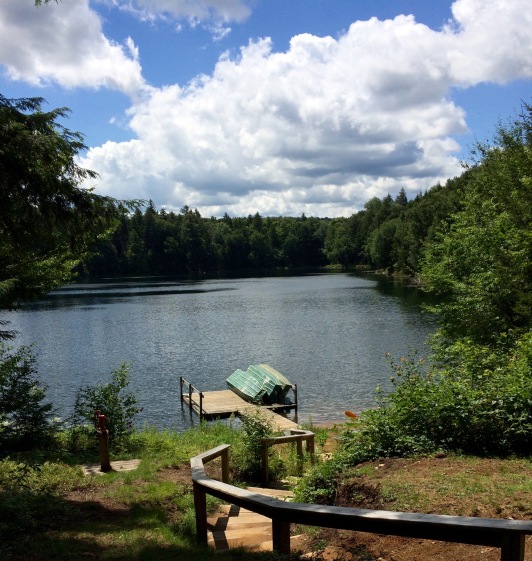
Green Lake Visit

I sit
splayed on Adirondack chair,
porched on rustic cabin,
built on rustic site.

Vista before me,
cropped not by gilded frame
nor dimmed by darkened glass
or visor’s cap.

Sentinel woods stand tall,
surround calm rippled waters,
beckon bare feet to rough hewn dock
and yet I sit.

Adirondack sky stretches above me,
bluing clouds to their brightest white.
And I breathe, deeply,
deep green forest scent.

I sit quietly content,
imagine myself
as notes within the loons’ song.
Eyes closed, I drift within this space
and imagine myself to stay.

IMG_4970

Written for Tuesday Poetics at dVerse where De asks us to write a poem that has to do with “blue.”
Photo taken this past week at Green Lake in the Adirondacks. I was indeed sitting on the porch of a rustic cabin at this beautiful remote site when I took this photo.
In the poem “blue” is used in the sense of “bluing.” According to  Mrs. Stewart’s Bluing site, there are 300 shades of white; the most intense includes a slight hue of blue. Mrs. Stewart’s Bluing is a laundry aid used to “brighten whites.” Hence the idea of the blue sky making the clouds appear even more white!