A Prequel Tale

Daedalus, inventor by trade,
created many a plaything for his young son.

Two wooden disks, string wound between them,
meant to be manipulated for fun.
“Like this,” Daedalus said.
The device rose up and down.
“Is that all it can do?” Icarus demanded.
“Give it to me and I shall see.”

Icarus strode to the woods
new toy in hand,
determined to test its true worth.
Hours later he returned,
blood, feathers and flesh
enmeshed in the now tangled string.

“Son, you must listen to me.
The new can be useful, but dangerous too.
Curb your recklessness
or one day I fear,
your fate will be similar
to the creature you’ve killed.”

Icarus dropped the now useless device,
picked up a stick and swaggered away.
Daedalus found him later that day,
bear grease covered his hands.
“Icarus my son,
what have you done?”

“Father, oh father, my fault it was not,
the stick too short, the fire too hot.”

“When will you learn, my darling son?
You are not an all powerful one.”
Icarus hung his head and quietly replied,
“I love you father. I promise you now,
I shall tether myself close to your side
never again, will I give way to my pride.”
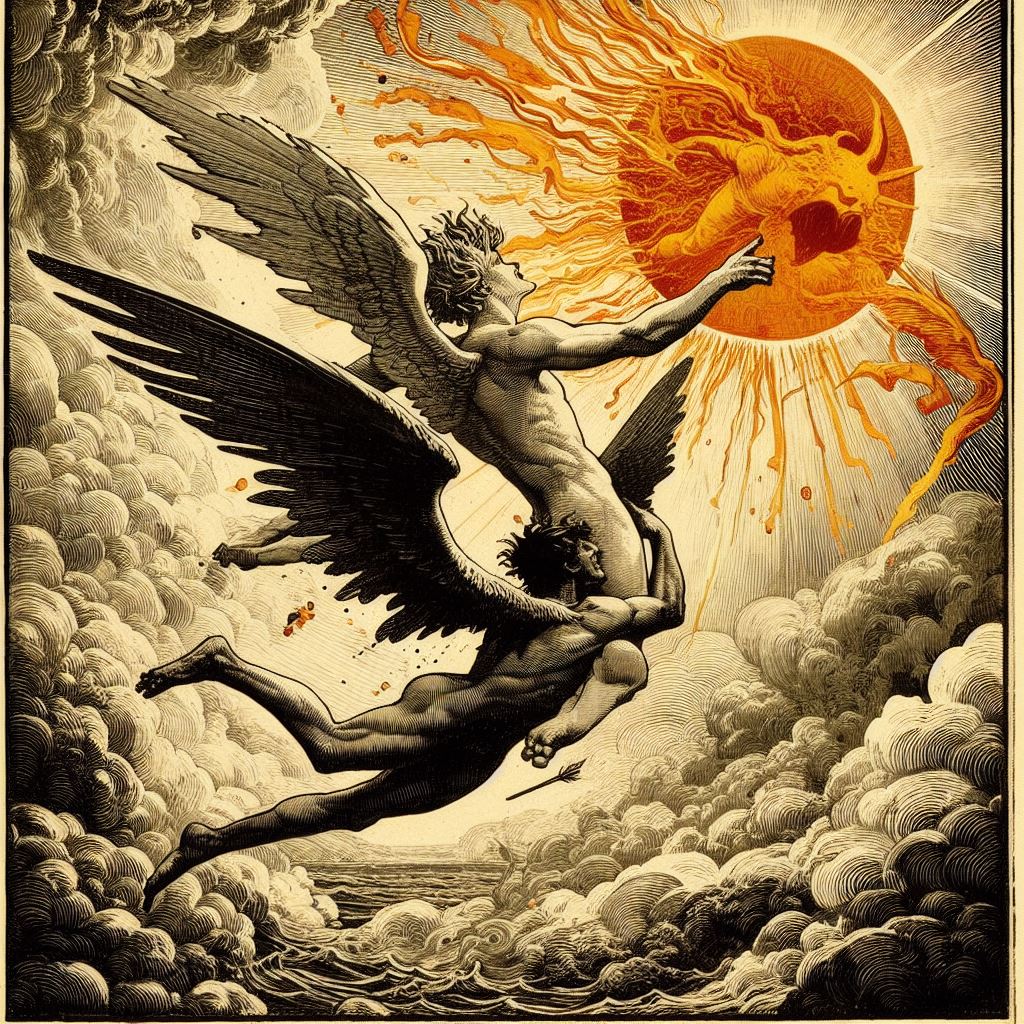
Written for Tuesday Poetics at dVerse, the virtual pub for poets around the globe. Today I’m hosting and asking folks to write a prequel for a famous character from a nursery rhyme, Aesop’s Fables, a famous book, or perhaps mythology. Writers should imagine a previous life for their chosen character. They should tell us about the character before they became famous. For example, what was King Cole like before he was a king? What about Alice as a toddler, encouraged her to fall down a rabbit hole and ultimately meet the Mad Hatter? What hints were there to her personality when she was very young? How or why did Peter Pan learn to fly? How did Hercules develop his muscles, and/or why? Writers should think about a famous character or mythological figure and write a poem showing a different side to them. It must however, be a prequel and their identity should be clear within the poem.

In terms of my prequel: Daedulus, a mythical inventor, created wings made of feathers and wax to escape from Crete where he and his son, Icarus, were held captive by King Minos. Icarus ignored his father’s warnings and flew too close to the sun. His wings melted and he fell to his death into the sea. Image created in Bing Create.
Claim Thy Power

Why is it women bear the blame?
Eve, in the garden of Eden
picked fruit from that forbidden tree.
With juice dripping down her chin,
she offered its flesh to Adam.
Adam took the bite, yet bears little blame.

Persephone, stolen away by Hades,
hungers for light in the underworld.
Eats six pomegranate seeds
only to learn she, not Hades,
bears the blame
for autumn and winter’s chill.

Who writes these tales?
Codifies them into myths believed?
Ah men, they are the shapeshifters.
I call on thee to reposition these stories,
reveal the weakness of Adam
the cunning treachery of Hades.

Take up the flowers, the scepter too.
Power in the womb, provider of the world.
Power in the breast, nourishment for all.
Power in the mind, our acuity revealed.
I call on you, deny your herstory no longer.
Claim your rightful place at the table,
and it’s not in the middle of the men.

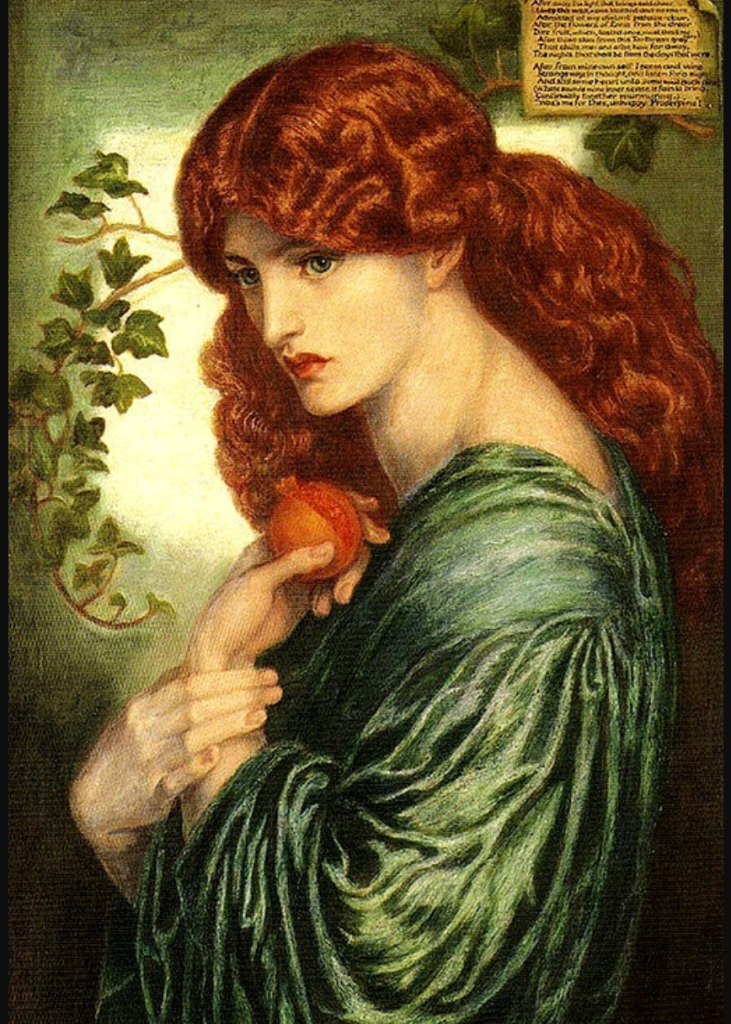
Written for dVerse, the virtual pub for poets, where today Sarah asks us to be inspired by the myth of Persephone and write a poem that is somehow related .

Persephone is the daughter of Ceres, the goddess of agriculture, fruit and grains. She was kidnapped by Hades and taken to the underworld. Ceres searched for her, leaving the crops to fail. Zeus, king of gods and father to Persephone, intervened and ruled that if Persephone had not eaten anything in the underworld, she could return to Ceres, above ground. Persephone had eaten six pomegranate seeds. Zeus consequently allowed her to return above ground for only six months of the year, thus creating the seasons. She is above ground for spring and summer, spreading flowers and seeds. She is below ground for autumn and winter, thus causing the demise of crops, flowers, etc. Image from Wikimedia Commons.

Convergence

Hands gnarled by fishing gear
introvert with lonely heart,
I’ve sailed the seas many a year.
I search the horizon,
especially in breaking dawn.

Skies painted tangerine,
meld into passionate reds.
Converge with glistening waters
awakened at first light as well.
She’s come to me only thrice.

Some say I imagine her. But I say to you,
I’ve cast my eyes upon that face
sweetly framed by seaweed tendrils.
I’ve marveled at her iridescence,
that silver-flecked aquamarine tail.

Once she rose up high as if to greet me,
as if to mimic the sun’s rising arc.
Her breasts, opalescent soft mounds
barely covered by white cap foam,
nature in its ultimate innocence.

I gazed until her eyes locked on mine.
That one glorious moment
etched sublime within my mind,
keeps me more at sea than ashore,
searching forevermore.

I seek that miraculous convergence
when divine dawn breaks early light
and she appears once more.
She, the sweetest balm in all the world,
for my aching lonely heart.

Written for dVerse, the virtual pub for poets around the globe. Today is Tuesday Poetics and Laura is hosting. She asks us to think about the poet as a painter. And most especially, she asks us to consider the ekphrastic poem: “The practice of using words to comment on a piece of visual art is an ancient one. One of the earliest and most commonly cited forms of ekphrasis occurs in The Iliad, when Homer provides a long and discursive account of the elaborate scenes embossed on the shield of Achilles… the term ekphrasis derives from Greek, where it literally means “description” and was formed by combining the prefix ex- (“out”) with the verb “phrazein” (“to point out or explain”)”. (Merriam Webster)”

HOWEVER, for this prompt, she gives us a number of artwork titles from contemporary artists and asks us to use that title, as the title of our poem – without looking at the actual artwork itself. With our words, we are to paint the story of or the image of that title. One title she provides for the prompt is Convergence by Jackson Pollack.

Image by Sharon McCutcheon:”Unsplash”

Searching

Still her ire for Orion
seethes within her aching breast.
Soulful search for daughter lost,
sends her through the nebulae.
Shedding tears each sparkling night
sorrow steeps in starry scrim,
solace never to soothe her.

Laura hosts Tuesday Poetics at hhttps://dversepoets.com. She asks us to write a poem in the Pleiades form: 7 lines, each with 7 syllable; a one word title; and each line must begin with the first letter of the title. Plus, she asks that we somehow write in relationship to the star constellation, Pleiades, sometimes called Seven Sisters.
In mythology, the Peliades (seven sisters) and their mother were pursued by Orion. And it just so happens, only six of the sisters (stars) are visible to the naked eye. Legend has it, one sister disappeared. Hence the content of Searching, written from the mother’s perspective.