I was with her when she died, only positive memories in my mind. Holding her hand, leaning down close, my mouth so near her ear.
Faith and love seemed to rush in overcome all doubt as I said, “Go toward the light mom. Daddy’s there, he’s missed you.”
Her eyes opened. She smiled at me – and then she was gone. What was the sound I heard before that last breath?
Not a death rattle. A sigh? A wooshing? Surely the machines near her. Or perhaps an angel’s wings? Helping her soar to another universe.
A place to reunite with my father, her son, her sisters and brother, her mother and father. A place with no pain, no loneliness.
I hope so. I truly hope so.
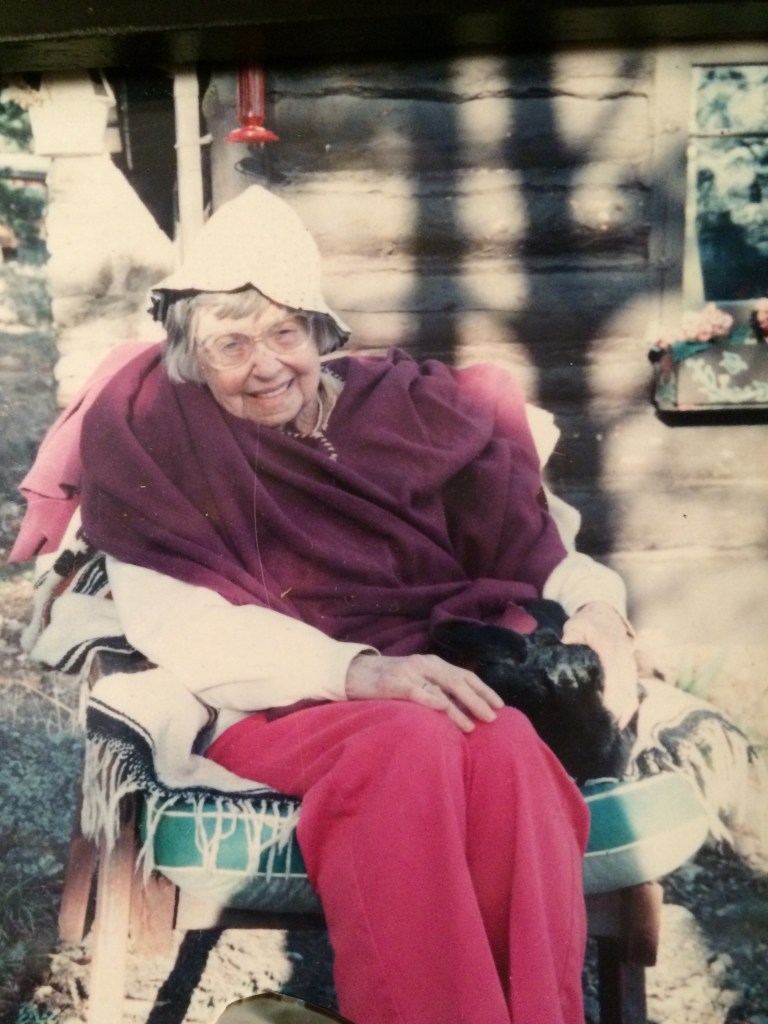
Written for Quadrille Monday at dVerse, the virtual pub for poets around the globe. We were asked to use the word “wing” or a form of the word, within our poem of exactly 44 words, sans title. I got so carried away in the emotional writing of the poem, that I went way over the 44 words. So posting it today for Open Link Night. Photo is one of my favorites of my mom, taken at my nephew’s cabin.
Of course she shed tears after 70 + years shared with her one true love. Since we first saw her Grace the world is a far different place. Her long life a gift from above.
I fancied the Royals forever it seems, listened to their wedding, dreamed my dreams. In 1947, I was only 9 but in love. A handsome prince, Philip, stole my heart but Elizabeth was his mate, never to part. Little girls like me dreamed of that kind of love.
Mother and I watched Elizabeth’s coronation. in the middle of the night I was filled with elation. Crowns, royal robes, jewels reigned from above. Philip stood tall as she became queen. Such pomp and circumstance I never had seen. He looked at her with such love.
Over the years I have admired the queen wearing colorful outfits, blue, pink or green matched head to toe, hat, coat, and glove. Children and grandchildren blessed her life. We saw very little of her role as wife until Philip died. Queen’s tears shed for love.
Written by Lindsey Ein and read aloud at our OLN LIVE! So happy to have Lindsey participate and to share her poem with all of you here.
It’s this day again. It’s come every year since this day nine years ago. An emotionally tough day in this autumnal time of year.
I awaken before dawn. Sleep elusive, memories churning. You cheated death on this day, nine years ago today.
I lie listening to your breath, thankful you are here. Thankful for angels along the way who helped tether you, tether you to earth and me.
This afternoon we will walk meander along the glistening Charles. We’ll scuff leaves with our feet, admire fall’s cacophony of colors and revel in a new day of love.
Photo taken last year along the Charles River in Boston.
Schooldays, schooldays, good old golden rule days . . . familiar words from a song my mother sang to me as she tucked me into bed. Generations later, I sang these words at bedtime to our young children, and then again to their children.
As a septuagenarian, I’ve been entrenched in schooldays from when I went to kindergarten until I rejuvenated (never say retired) in December 2012. Schooldays were part of my life as a student, a parent of school-aged children, a teacher, and finally as a university administrator. Whether we lived in rural Iowa, or a city, August always signaled summer’s end. More importantly for me, it was the harbinger of schooldays to come. Depending on my age, it could mean cutting up brown paper grocery sacks to make textbook covers; or shopping for new crayons, knee socks for my uniform, #2 yellow pencils, new Bic pens and notebooks, or a new sweater set. Later it signaled filling out a new lesson plan book, or noting upcoming meetings in a day planner. At seventy-five, back-to-school ads on television bring back memories of August days gone by.
sweetcorn season done seed corn soon to fill silos school bells ring again
Written for dVerse, the virtual pub for poets around the globe. Today Sanaa is hosting and asks us to write about what August means to us. We can use any poetic form we choose. I decided to write a haibun.
Haibun: a poetic form that includes one or two succint paragraphs of prose followed by a haiku. The prose cannot be fiction. The haiku must include a seasonal reference.
The summers of my privileged youth were filled with riding bicycles with my best friend, June; drinking from the garden hose; drawing hopscotch grids with colored chalk; climbing Mrs. Jester’s apple trees; running through sprinklers in the back yard; and fishing off the Lake Michigan pier with my dad. Once every summer, my mom bought a box of popsicles and doled them out to me and my friends. Everyone else fought over the red ones. I always had the yellow ones to myself. I guess nobody else liked banana.
hot city summer steam hovers over pavement tempers flare, guns pop
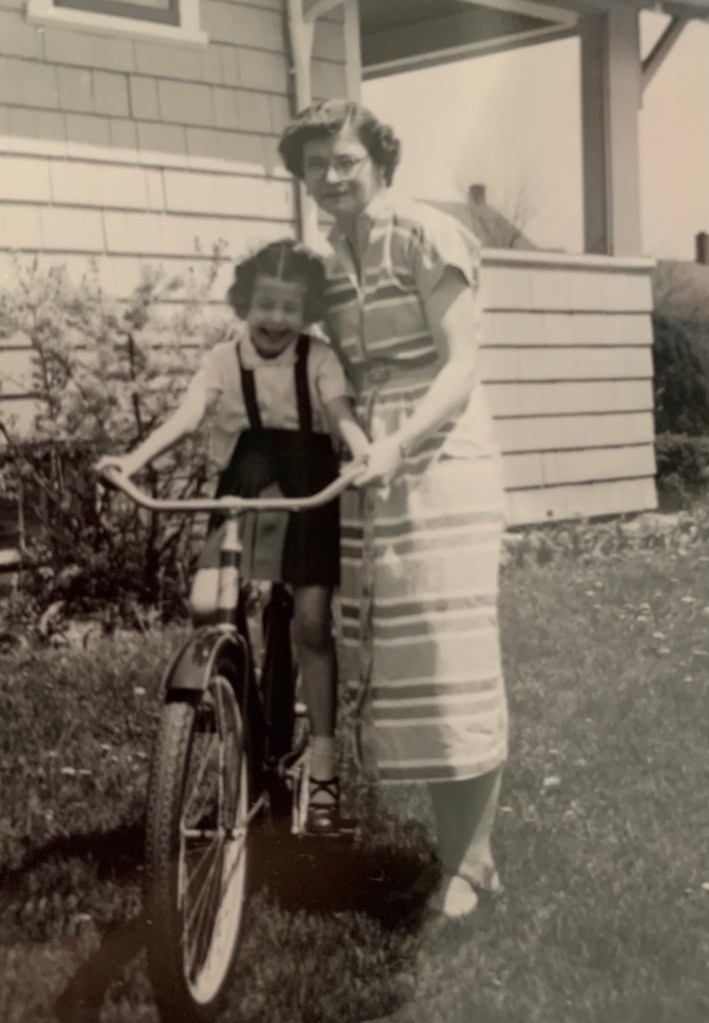
Frank is hosting haibun Monday at dVerse, the virtual pub for poets. Today he asks us to consider summer. Photos from my childhood, in the early 1950s. Pub opens at 3 PM Boston time. Come join us!
Haibun: one or two paragraphs of succinct prose, usually biographical in nature, followed by a haiku that amplifies the theme, but does not duplicate the prose.
When I think about myself there is a deep brooding. The day hangs heavy no sound falls. I see you, shadows on the wall just beyond my reaching.
Lying, thinking I almost remember when you came to me, unbidden. Your smile, delicate a young body, light, your skin like dawn. We saw beyond our seeming.
One innocent spring it occurs to me now, the dust of ancient pages.
Every line in this poem, is the first line in one of Maya Angelou’s poems. The poems are listed below, in the order of their appearance:
When I Think About Myself My Arkansas Greyday After Thank You, Lord Life Doesn’t Frighten Me Slave Coffle Alone I Almost Remember When You Come to Me Woman Me To Beat the Child Was Bad Enough Passing Time We Saw Beyond Our Seeming Now Long Ago Changing Communication II: The Student
Rain drops glisten daffodil petals. Forsythia blooms in Mrs. Jester’s yard. Buttery yarn disappears from hank, chain-stitched and double-crocheted by arthritic fingers on blue-veined hands. Children with yellow chalk-smudged cheeks squat on sidewalk squares. Round smiling sun in place, they draw happy flowers below.
Written for NAPOWRIMO, Day 18 and dVerse, the virtual pub for poets around the globe: both prompts coincide nicely in this poem.
It’s Quadrille Monday at dVerse. The word to put in our poem of exactly 44 words (sans title) is “chalk” and the pub opens at 3 PM Boston time.
The NAPOWRIMO prompt is to “write a poem that provides five answers to the same question – without ever specifically identifying the question that is being answered.” The question I’ve answered is “What are yellow things you might see in the spring? My answers are daffodils, forsythia, yarn, chalk-smudged cheeks, and the sun.Photo is from Pixabay.com
** I grew up in Waukegan, Illinois. The house I lived in from the time I was two until I went into third grade was at 144 South Butrick Street. Mrs. Jester was our elderly next door neighbor.
Our lives are made of moments, some plain, some filled with awe. Looking back I was surprised how many included sipping through a straw!
My mother showed me how to sip orange juice to go with grahams; Then coca cola and ice cream sodas helped make me who I am. Chocolate milkshakes, creamy and thick should be against the law. The memories sweet, of all those times sipping through a straw.
In college I learned about Scotch Mists, served with straws black and thin; As were those Mai Tai’s with rum and gardenias that almost did me in. Anything sipped through a straw was yummy. To me a special treat, Until the memories of hospital stays I do not wish to repeat.
When your lips are cracked, your mouth is dry and your body feels so raw There is no better thing the nurses can bring than water to sip through a straw. It’s funny the things that come to mind; the adventures, the things you saw. My life’s special moments have often come when sipping through a straw.
Straws is written by Lindsey Ein: wonderful writer, wonderful friend, and mother to our dear son-in-law. She shared this poem with dVerse LIVE on Thursday – I’m just a bit late posting it.








 lillian the home poet