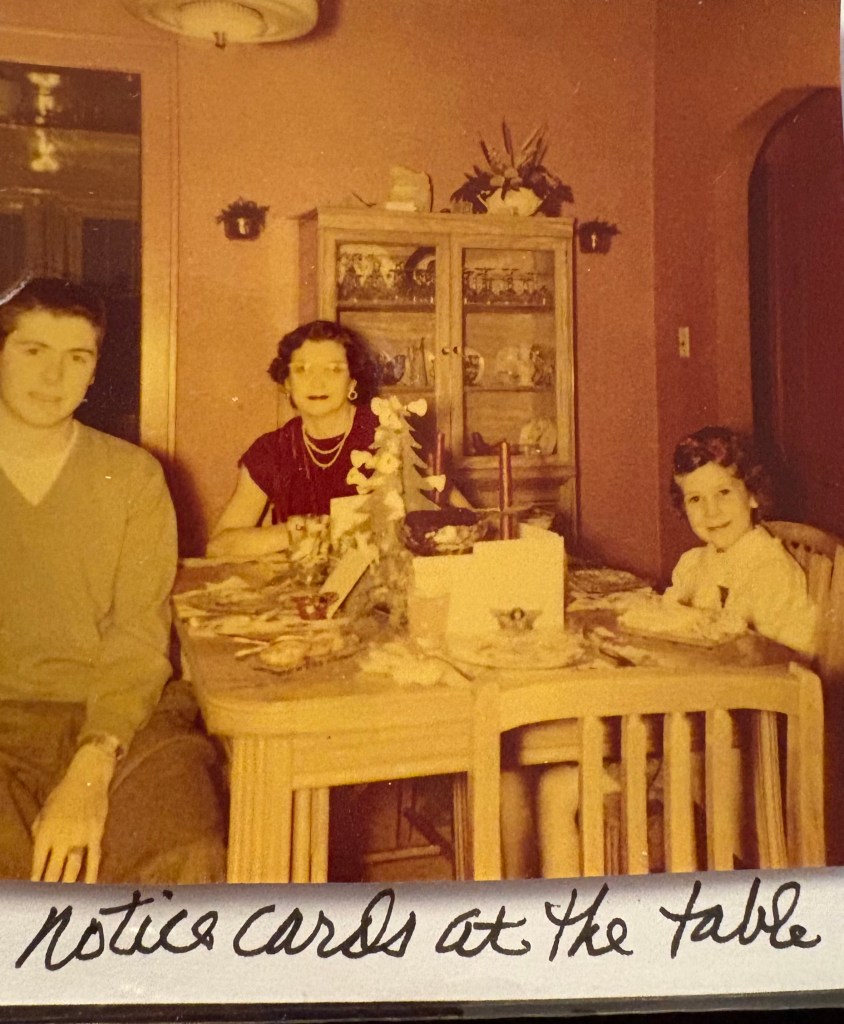
. . . our December twenty-fourth dinners with Alice’s jello salad and pineapple-coconut bars. Rather than bowing our heads and saying grace, we shared cards at the table. One for my mother, dad and brother. And theirs to me.
Raising our family, the tradition continued. Handwritten notes inside meant the most. Some just covered with Xs and Os, some with a memory from that year. Always a personalized declaration of love.
Alice’s recipe is long forgotten. But miles away, with children of their own, our children still live the card tradition. Now, almost in our octogenarian years, we still smile knowingly on those nights as we reach for the personalized card on our plate.
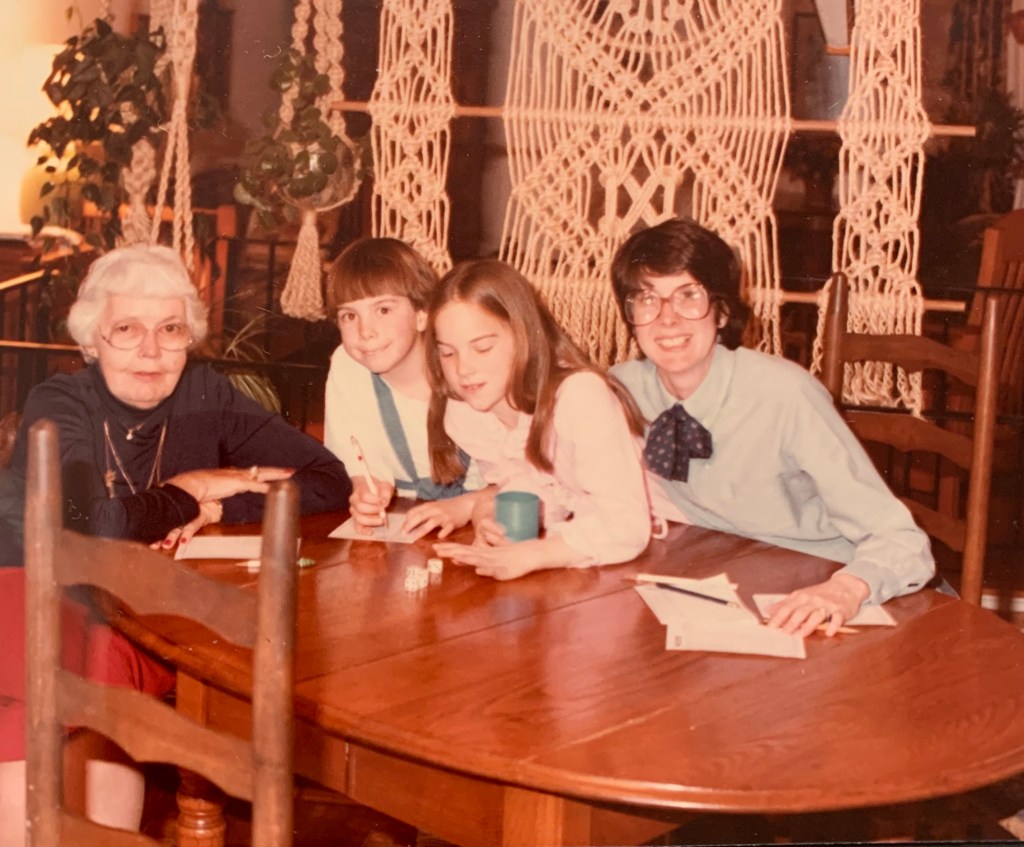
It’s NAPOWRIMO (National Poetry Writing Month) day 2! Today we’re asked to “write your own poem in which you recount a childhood memory. Try to incorporate a sense of how that experience indicated to you, even then, something about the person you’d grow up to be.” Photo from an old photo album…note the writing at the bottom of the photo. Yep, that’s me with my brother (9 years older than me) and my mother.
From the time our children were two and four, we’ve held hands before our evening meal and sung a song called The Circle of Love. With a simple and happy tune, the words go like this:
“The circle of love goes around and round the circle of love goes around. Reach out your hands someone needs you. The circle of love goes around. Amen.”
It’s not by others’ standards, a real table grace. Grace is often defined as the free, unmerited favor and love of God toward humanity. And a short prayer before a meal is often called “saying grace”. For us, this singing together before supper was and always is a moment to celebrate family. Smiling at each other, sometimes grinning, we sing loudly and with energy. What we’re really singing about is the unconditional love and happiness we share. No matter the food – from cheesey chicken casserole to shrimp scampi to Thanksgiving turkey, The Circle of Love was always the first course of the meal.
Now, approaching our octogenarian years, with five grandchildren who are twenty, eighteen, and fifteen, and our children and their wonderful spouses in their fifties, we treasure the rare times we are all together. The eleven of us, or a fewer number on occasions when busy lives and miles intervene, still carry on this tradition. When we come to the table for an evening meal, no matter the happenings of the day, the first thing we do is join hands. And then we sing, loud and clear. Grateful for each other and for the meal we share.
Wild flowers in fields different shapes, sizes, colors always face the sun.
Written for dVerse, the virtual pub for poets around the globe. Today Punam is hosting Tuesday Poetics presenting us with the following prompt: “For today’s Poetics, I would love a presence of food in your poems. You can employ any form but touch upon food; vegetables, fruits, meat, dairy, desserts you love or hate. It could be about why you love/abhor cooking/baking, your most memorable/miserable meal ever, your relationship with food…the possibilities are endless.” No particular form or length is required. A Haibun is a Japanese poetic form that combines prose with a haiku. I guess you could say I’ve written about my family’s relaionship with the evening meal!
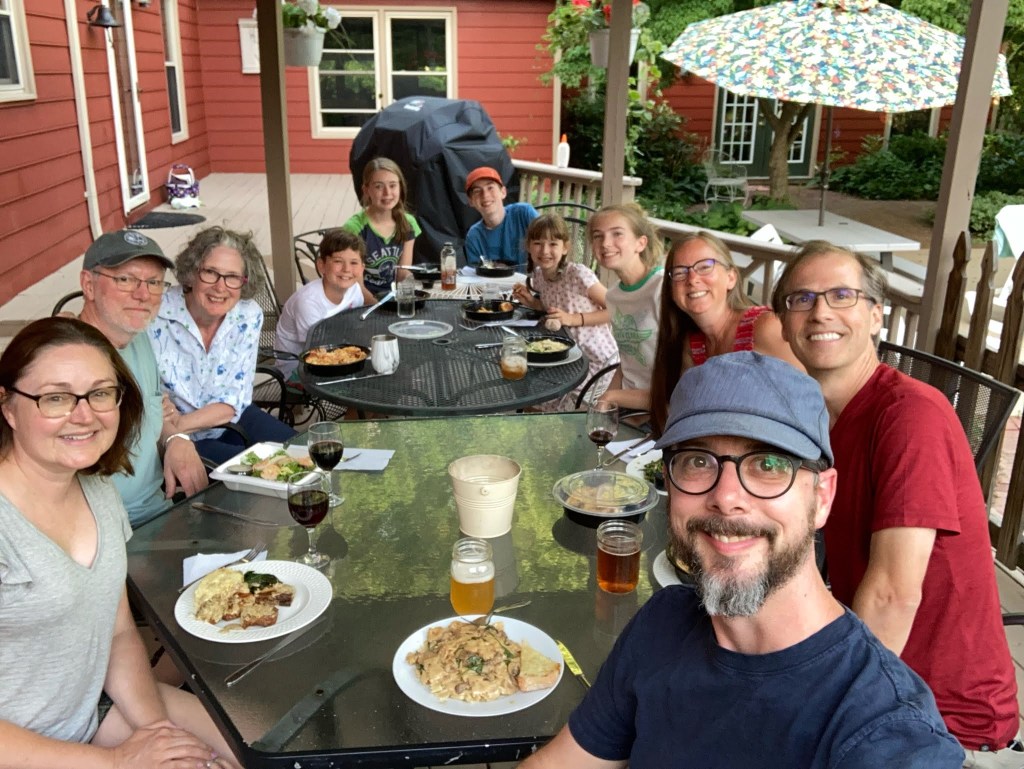
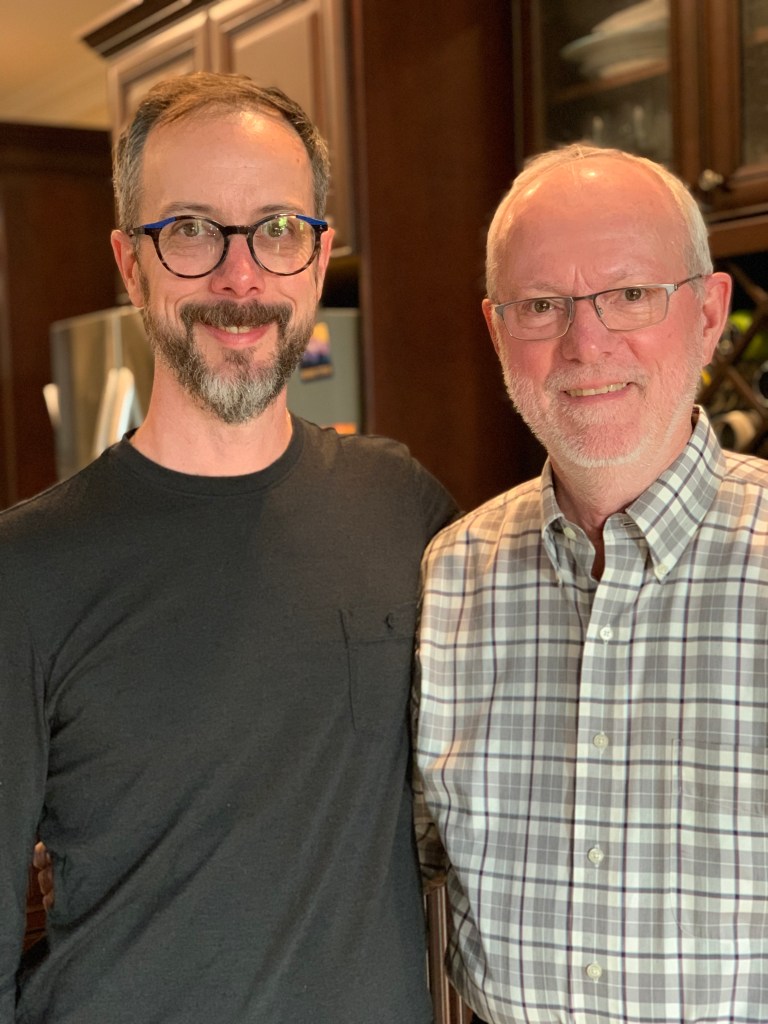
Photo is from a family gathering about six years ago.
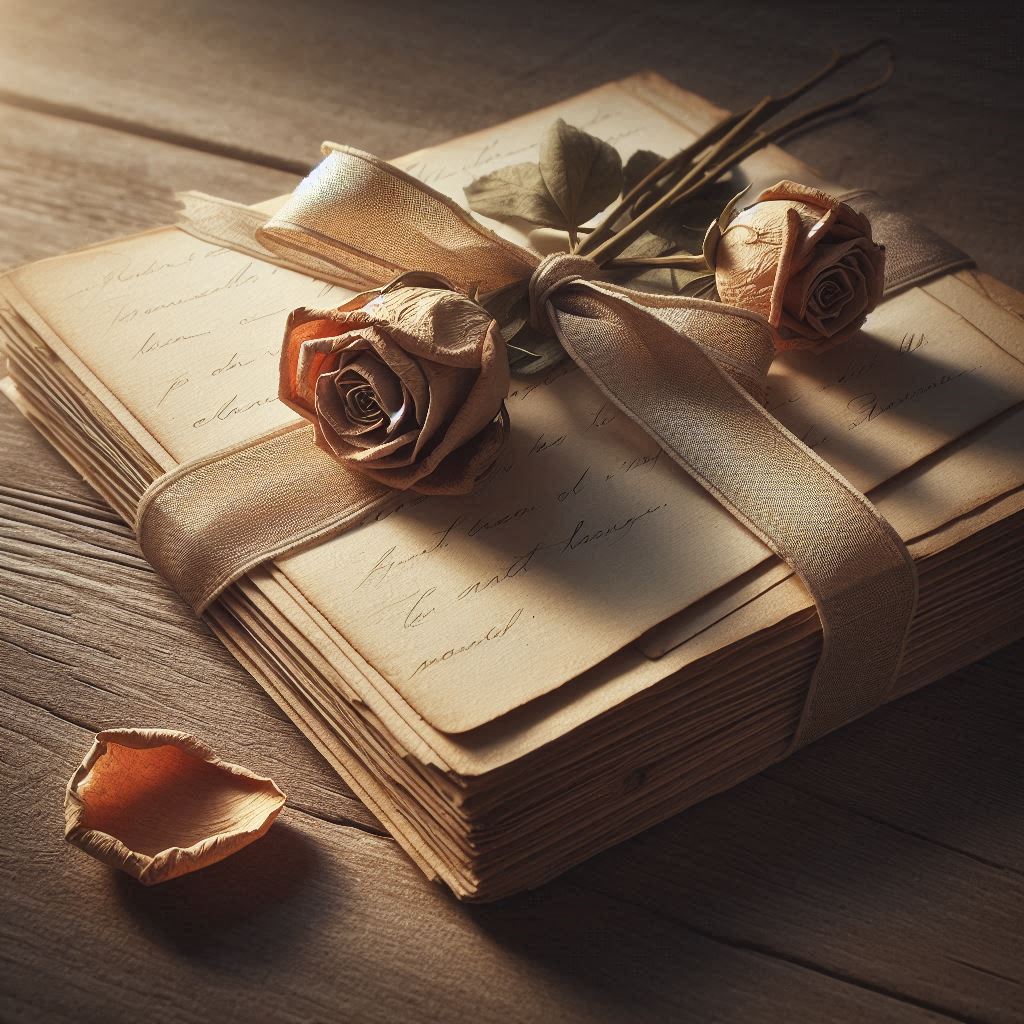
Summer of letters. Days of thinking slowly, rolling words around until they landed just right. Days of ink to vellum, sometimes blurred by tears. Hidden away for so many years. Flowers beneath ribbon ties, now brittle and dry. Love never consummated, memories still blush.
Written for dVerse, the virtual pub for poets around the globe. It’s Quadrille Monday and De asks us to include the word “flower” or a form of the word, within the body of our poem of just 44 words, sans title. Image created on Bing Create.
Never planned to join the circus, although there is a hereditary tendency. My Uncle Bob ran away to the circus, several times. But he always came back.
Never planned to join the circus, but what a circus we’re living in now! Twenty-four-seven news cycle, clown leading buffoons under the big top.
Never planned to join the circus, but it’s tempting to become an escape artist. I’d lose myself in romance novels and Netflix, or any kind of my own-made cocoon.
Uncle Bob, if you’re anywhere out there, somewhere in the cosmos, help us find our way back home again. Just like you always did.
Kim is hosting Tuesday Poetics at dVerse, the virtual pub for poets around the globe. She asks us to write a poem “that starts with a surprising hook, which can be one to three lines, but must develop into a fully-fledged poem.”
A bit of explanation: in a few years, I’ll become an octogenarian. I actually did have an Uncle Bob, who every time his wife became pregnant, ran away to the circus. Absolutely true – he had four children so he ran away four times! But he always came back- well before they were born. He was a wonderful uncle and as my childhood memories recall, had a lot of fun with his kids.
PS: here in the U.S., this is no time for any of us to be escape artists. It’s time to speak out, stand up, and resist!
Teaching skills. Helping. Watching. Too soon the dividing line appeared, between the now and what was coming.
Responsibilities increased. Yours not ours. Your departures, more frequent, measured at first in hours, not miles.
Your wings. Expected, prepared for. We marveled and smiled. Waved at you . . . and then you were gone.
Distance multiplied. Time stretched separations. Hairline fractures of the heart, smiling our love through goodbyes.
Parenting children to adulthood. Learning to live through changing times, adjusting to the moving margins.
Written for dVerse, the virtual pub for poets around the globe. Today Dora asks us to write about a poem that somehow talks about margins. She gives many examples of margins. As a septuagenarian with two happily married children and five grandchildren, I thought about living through moving margins as a parent and thus, this poem.
The last of my generation. Savoring my cigarette, I sit blowing smoke rings. They dissipate into wispy nothingness, metaphorical for my existence these days. I’m not alone in this assisted living complex. But I am lonely. With my failing eyesight, I no longer escape on adventures with Agatha Christie or James Patterson.
I have so few pleasures. Sometimes I’ll listen to Duke Ellington records and I’ll bury my soul in a scrapbook with the photographs there. And the moss that I imagine in my dreams, always beneath my husband’s feet. I can see it when I bend over the pages with my magnifying glass, in the picture of John standing beside our first tent. Memories come alive on the pages. My children’s birthday celebrations, cheeks pooched out, blowing candles. I’ve been blessed. My life has been good. But oh Lord, it’s time. It’s time.
Written for Prosery Monday at dVerse, the virtual pub for poets around the globe. Today, Kim asks us to include the line “And I’ll bury my soul in a scrapbook, with the photographs there and the moss” in our piece of flash fiction that is 144 words in length, sans title. The line is from the poem Take This Waltz by Leonard Cohen. We may change the punctuation of the required line, but must use the words exactly, in the exact order as appears in Cohen’s poem.
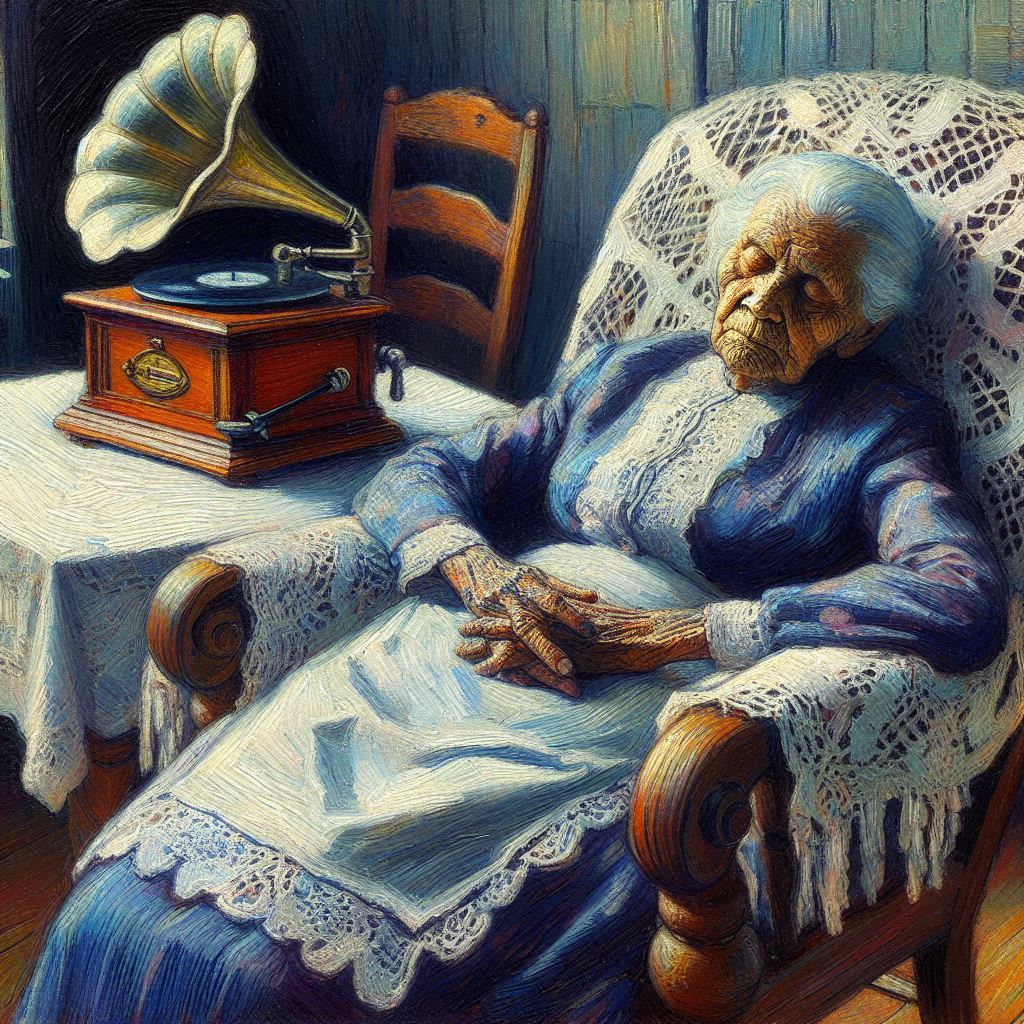
Victrola plays Glen Miller’s Moonlight Serenade. She sits dozing, blue-veined hands quiet, elbows on doily-covered armrests. Asleep, she was dancing with him. Awakening to reality she stares at his empty chair. Only a figment in her dreams now, she still misses him every day.
A quadrille written for dVerse, the virtual pub for poets around the globe. I’m hosting today, asking folks to include the word “figment” (or a form of the word) in their poem of exactly 44 words, sans title. Image created in Bing Create.
“No man ever steps in the same river twice, for it’s not the same river and he’s not the same man.” Heraclitus
Some years back we found ourselves near the town I grew up in – Waukegan, Illinois. I’d not been there in decades. We decided to take a detour in our planned trip and drive by some of my old haunts.
Sadly, the house I lived in for my first nine years was in a state of disrepair. Rickety porch steps, missing shingles. My mother’s beloved lilac bushes were no more. The downtown where I’d “scooped the loop” in the front seat of an old Chevy was barely recognizable. Not one store name was the same. Most jarring was my walk through the Catholic church I grew up in. How could it be so small? I remembered lighting candles inside a hushed space – a side grotto/cavern made of dark rock. There I stood, inside the grotto, looking at battery operated candles and grey plastic simulated stone walls. After lighting a candle and saying a small prayer for my mother, I decided to end our nostalgic tour. I wanted to keep the rest of my memories intact.
stream rushes surely rocks tumble and change their shape nothing stays as is
Frank is hosting Haibun Monday at dVerse, the virtual pub for poets around the globe. His prompt for today is to “imbue our haibun with mono no aware. Write on any topic that you like as long as your haibun embodies that wistful sadness marking the beauty of transience.” A haibun combines prose and a haiku.Image is a photo I took some years back on one of our vacations.
When I was very young time meant having fun. The road ahead of me . . . well I couldn’t see the end much less fathom the turns, detours, or optional routes in the long journey to come.
A septuagenarian now, closer to eighty than seventy, my memories are glued in scrapbooks. From early marriage days to birthdays and holidays, newspaper clippings, and recital programs.
Wedding albums, birth announcements. Photo albums filled with tent-camping vacations, early grandparenting days, family reunions, scenery shots from cruising days.
There is no doubt about it, time is a glutton. It eats up seconds, months, and precious years. But if we could stop it, collect special events, and put them in a bottle, the question is, at what point would we do that?
What would be the ripple effect? Which moments might be lost, what aspects of human development might be missed in that stutter moment between stopping the clock and starting it again? Can we really judge what is significant enough to stop everyone’s else’s world to save our own?
And just as important to consider, how many bottles would we need?
Written for NaPoWriMo day 17 where the prompt today is to choose a song, and write a poem whose title is the name of the song. Time in a Bottle was made popular by Jim Croce.
Praises to the table, the one our family gathered round. You held court with meals, never minded spilled morsels. Gained rings in the process from sloppy milk glasses.
You listened without judgement. Heard the hijinks of Mrs. Piggle Wiggle, knock-knock jokes, teacher complaints, family disagreements, high school gossip, vacation plans, college choice deliberations, and joyfully sung table graces.
You welcomed guests who crammed in extra chairs. More elbows leaning in, more spills, raucous laughter. Birthday party guests and gangly teens who occasionally kicked your legs.
Now in another house but still in the family, serving another generation. From toddlers punching playdough to kids’ paints slopping on your surface, you still stand proud after all these years.
Written for day 9, NaPoWriMo. The challenge is to write a poem every day in April, which is National Poetry Writing Month.
The NaPoWriMo challenge today, takes a page from the famous poet Pablo Neruda. His poetry, translated to English, is treasured by many. Among his poetry are a series of Odes. An ode is a poem written in praise of a person, place or object. The challenge today? “Write your own ode celebrating an everyday object.”
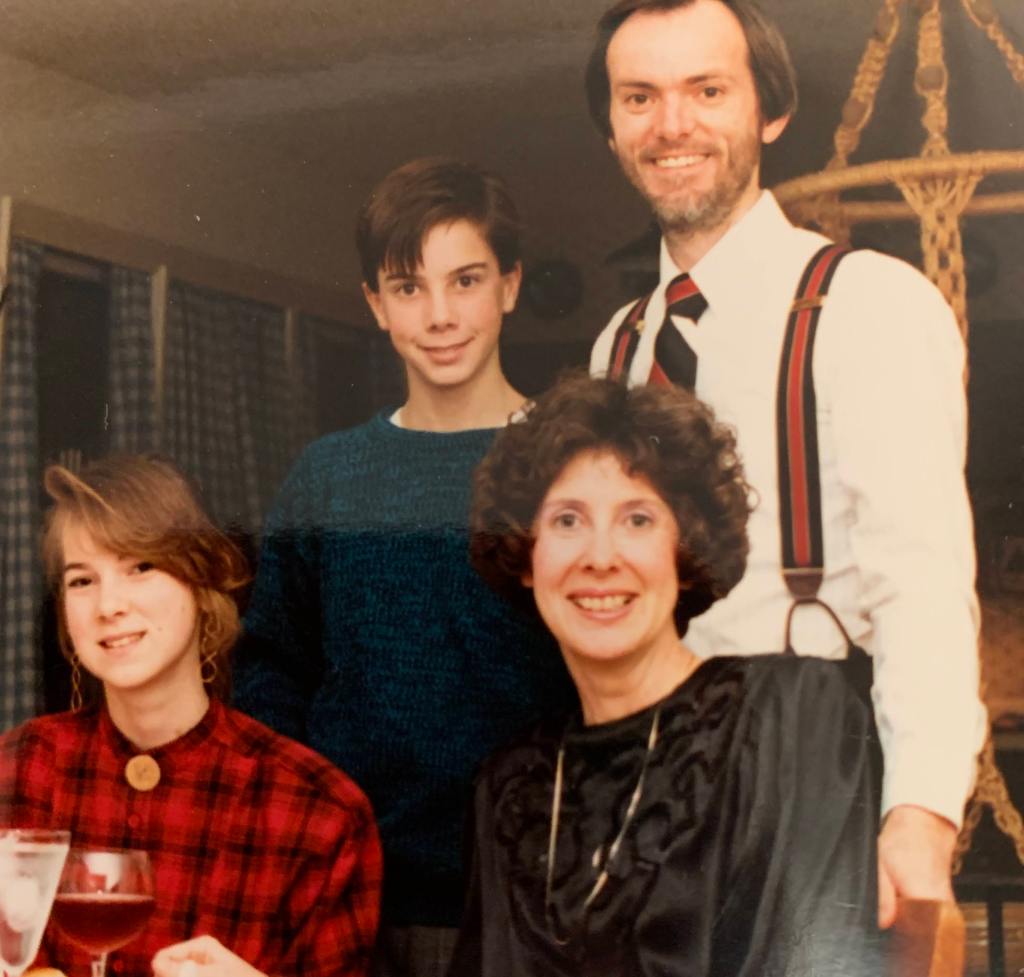
Photos are of our family table over the years….could not find any when our kids were infants or toddlers. We sure celebrated many a birthday at this table! The table has been at our daughter’s home since her children were very young. They grew up at the same table their mama and uncle did. Last two photos are of our daughter’s and son’s children sitting at the table in more recent years.










 lillian the home poet