Poet’s Parisian Interlude

Sipping bordeaux, afternoon delight.
She, the queen of hearts, oblivious.
He, her soul’s sustenance, sits restless
in the tangles of foment.
His love, her peace and windrush.
His lust, her quicksilver.

Poetry is a testament to noticing.
Journal upon the table, pen hesitates,
writing stammers, then suddenly stops.
Eyes look up, gaze high.
Sentinel Eiffel Tower looms
overlooking this changing scene.

Her hands shake, tears form.
Looking at him, she knows.
This seasonal song has no coda,
final movement complete.
He nods slowly, touches her hand,
whispers I’m sorry and leaves.
For her, the summer is done.

Written for Tuesay Poetics at dVerse, the virtual pub for poets around the globe. Today Merril gives us a list of names given to roses and asks us to write a poem including at least five of the names. We cannot use the word “rose” wtihin our poem. The rose names are Afternoon Delight, Bordeaux, Brass Band, Cayenne, Desdemona, Ebb Tide, Eiffel Tower, Golden Gate, Mermaid, No Surrender, Peace, Penny Lane, Queen of Hearts, Quick Silver, Restless, Sea Foam, Summer Song, Tangles, White Wings, and Windrush. I’ve included the ten that are in bold print.

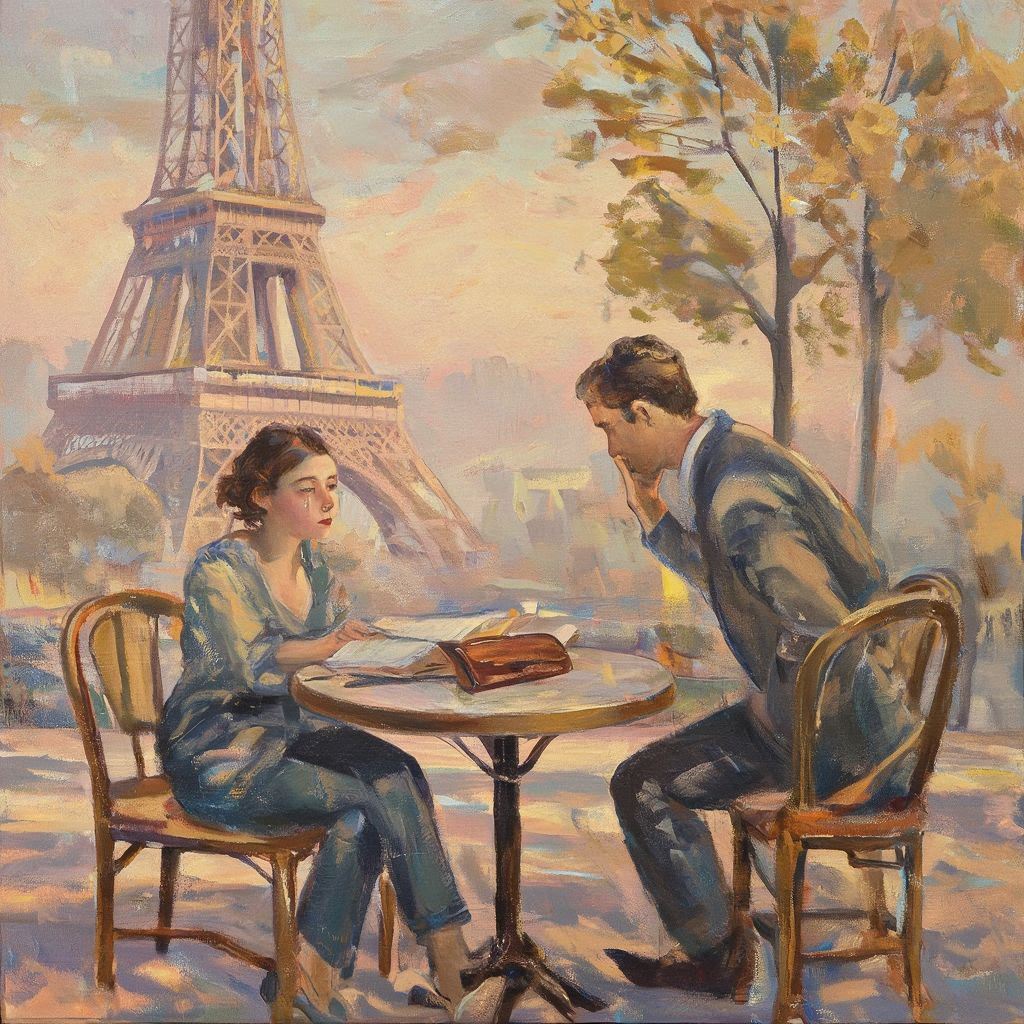
Image AI generated on Bing Create.

“Poetry is a testament to noticing” quoted from Poetry Unbound, 50 Poems to Open Your World, by Padraig O Tuama, Irish poet and theologian.

Tussie Mussie Life

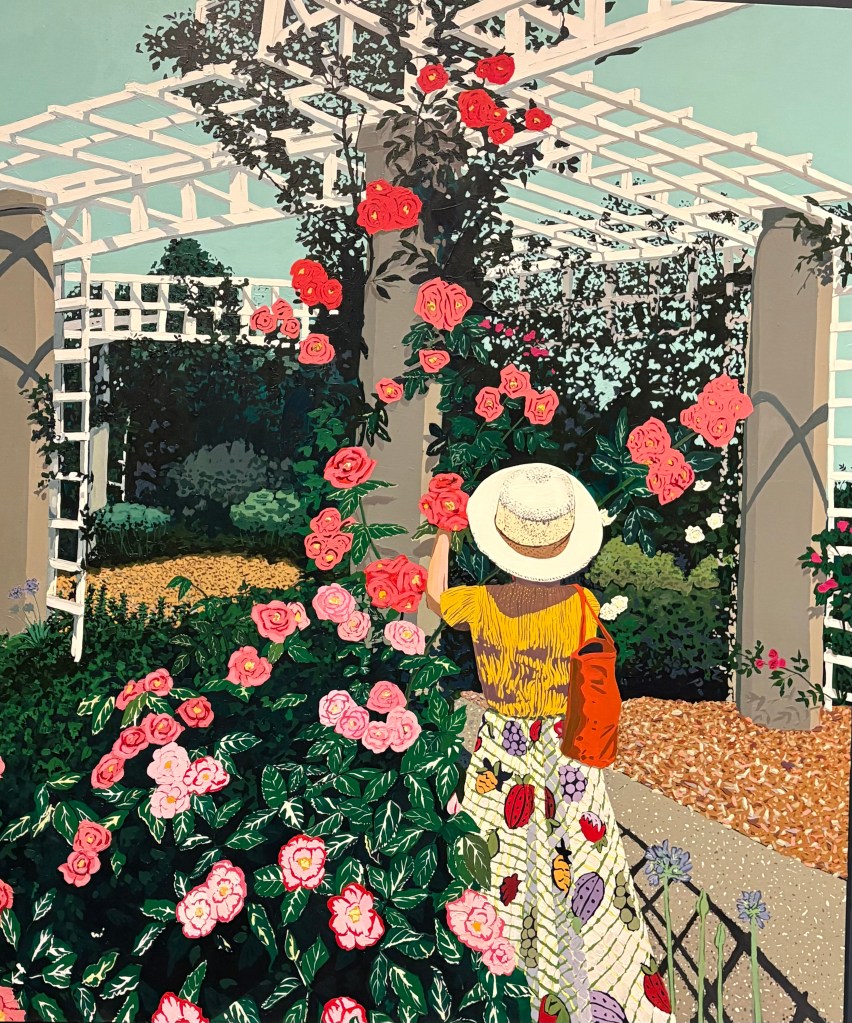
She bloomed in every setting.
Rose patterned everyday dresses,
cherry cheerful flannel pajamas,
fruit speckled summer skirts.
Wisteriaed wall paper
wooed her to sleep each night.
Bougainvillea borders
bedecked her breakfast nook.
She lived up to her name,
Lily lived a lovely cheerful life.


Written for Quadrille Monday at dVerse, the virtual pub for poets around the globe. Today I’m hosting at the pub and asking folks to write a Quadrille (a poem of exactly 44 words, sans title) that includes the word “bloom” or a form of the word.

Image: Hopie in the Garden, painted in 2021 by Hilary Pecis, on display at Boston’s Museum of Fine art in their Framing Nature: Gardens and Imagination exhibit.

Explanation of Tussie Mussie: During Queen Victoria’s reign (1837 – 1901) a small bouquet of flowers called a tussie mussie was a common accessory. Flowers were considered more modest adornment than jewelry for young women.

On the Banks of the Charles

I meander the riverside. Meanwhile the
globe spins frenetically, as much of the world
is amok in violent rhetoric. Walking offers
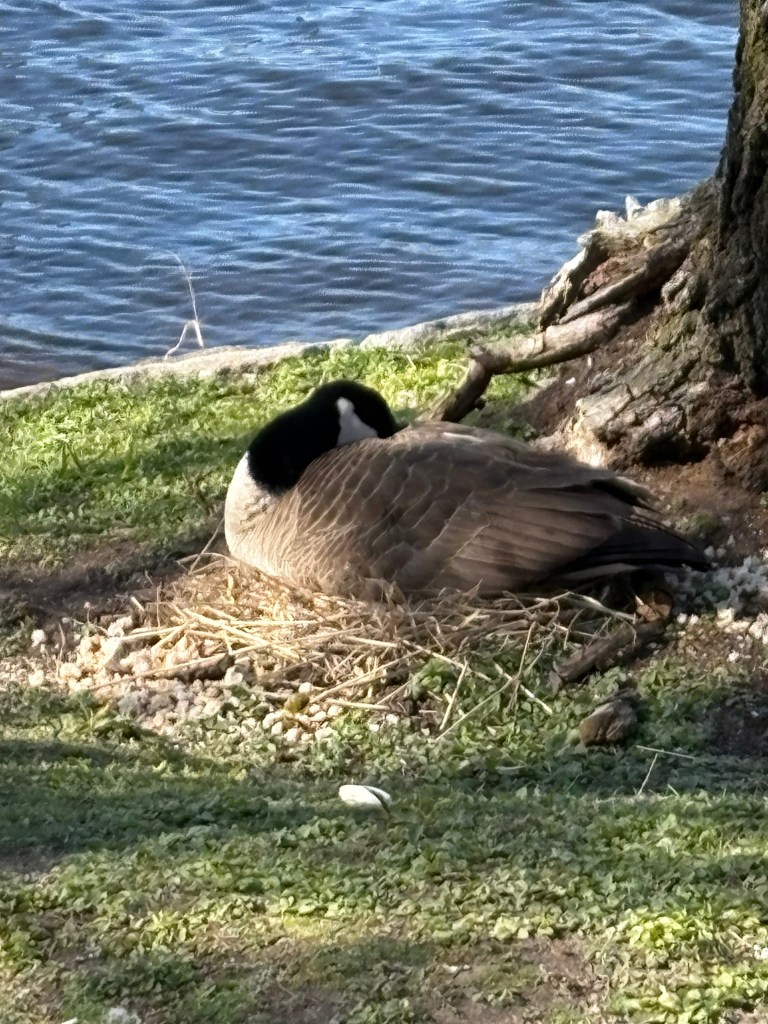
views of spring. Geese nesting, itself
testament to the season’s rebirth. To
see the female sit patiently upon her nest, your
reminder. Hope lives within the imagination.

Written for Meet The Bar Thursday at dVerse, the virtual pub for poets across the globe. Today we’re asked to write a Golden Shovel Poem.

What is a Golden Shovel Poem? It’s a poetic form where the last word of each line in a new poem, when read vertically from top to bottom, creates a line from another poet.

What line from another poet have I used in my Golden Shovel Poem?
“The world offers itself to your imagination” from Mary Oliver’s poem Wild Geese.

Photo taken on my walk yesterday, along the banks of the Charles River here in Boston.

We Must Learn from Others

Lessons from ancient cultures,
wisdom in Native Americans’ ways.
Guiding principles to live in harmony
passed down from generation to generation.

Debwewin is Truth.
Represented by the turtle.
The tortoise carries lessons of life on its back.
Years piled upon years.

It walks slowly,
sometimes laboriously,
feet firmly planted in earth’s reality.
Its purpose was, still is, forward movement.

Honest plodding, slogging, traipsing at times.
Memories, achievements, failures, goals.
All stored and carried through life’s journey.
No regrets. This is me. In this place. Now.

Everything past, a part of my weight,
my girth, my being, my soul.

Written for Tuesday Poetics at dVerse, the virtual pub for poets around the globe.
Today Mish is hosting, providing us with a very special prompt that explains The Seven Grandfather Teachings, a set of Anishinaabe guiding principals for living a good life in harmony with nature and others . . . all of creation.


Mish explains:These ancient teachings have been passed down for generations through stories and ceremonies. Many Native American organizations have adopted these sacred laws as a foundation. Because they are the basis for a worldview rooted in respecting each other and the natural world, these values are often represented by a specific animal. We’re asked to write a poem influenced by the Seven Grandfather Teachings in any way that we would like. We may choose to focus on one or embody them all.

I’ve chosen to write about Debwewin, Truth, represented by the turtle. “The turtle carries the teachings of life on his back. Slow and meticulous. Understand the importance of the journey. Be true to yourself. Speak your truth.

Where Does Love Go?

Family of four,
both mother, father gone now.
Their love still lives on
in the way their children love.
Circle of love unending.


A Tanka written for Tuesday Poetics at dVerse, the virtual pub for poets around the globe. Kim asks us to write a poem using the title Where Does Love Go and answer the question within the poem.

Go to https://lillianthehomepoet.com/2026/03/24/a-haibun-family-tradition/ to understand my personal meaning for the Circle of Love. Image from Pixabay.com

Tanka: a Japanese poetic form of 5 lines with the syllabic count of 5-7-5-7-7 Some say it’s a haiku that keeps on going!

In the time of Emily Dickinson . . .

She stood on the Trader’s Block. Men walked by and stopped to examine her. Many with whips in their hands. Some more gentlemanly with canes. Either way. They stopped and stared. Demanded she open her mouth; forced her to do so. Were her teeth in good shape? They all wanted a healthy robust woman to work in their fields. They didn’t know she could read. She’d seen the poster on display. Slaves for Sale Today. That horrible publication. Is the auction of the mind included with the auction of the body? For her, it will never be so. She can read. She can think. She can read the stars. She will not be long with whomever buys her today. She will try to escape again and this time she will succeed.

It’s Prosery Monday at dVerse, the virtual pub for poets around the globe.

Today, we’re asked to write a piece of prose (144 words or less) that includes the line “Publication is the auction of the mind” from Emily Dickinson’s poem Publication – is the Auction. We can change the punctuation of the line, but we may not change the order of the words. Emily Dickinson lived in the time of slavery. She was not an activist on the subject however, the subject was actually or metaphorically a subject of some of her poems.

I chose not to include an illustration today.

Street Art in Chile

I believe this is us forever dear,
painted image on a neighbor’s wall.
We hold hands in permanence,
street artist’s portrait of love.
His rendition, always young.
No furrowed brows from worries,
no age spots upon our arms.
He sees us somewhat oddly though,
large heads upon small bodies.
But we do lean in, faces touching,
projecting forever togetherness.
Feet dangle above his painted ground,
hovering above reality’s sidewalk.
He’s placed us in suspension here. . .
and I can imagine, my love,
this was us so many years ago.
How did he know?


Written for Open Link Night at dVerse, the virtual pub for poets around the globe. I’m hosting today, and folks are invited to post one poem of their choosing, no required format, topic, or length. OR they may post to the optional prompt I provide which includes three photos of street art I saw in Valparaiso, Chile some years ago. The one above was one of my favorites.

AN INVITATION TO YOU: I’m also hosting our LIVE session (audio and video) on Saturday, April 11, from 10 to 11 AM EST. Please consider joining us! You may read aloud a poem of your choosing, or just come to sit in and listen! We are indeed a global group with folks from Australia, Trinidad Tobago, Kenya, the UK, Pakistan, Sweden, and across the US often in attendance. The more the merrier! If you’d like to join us, go to https://dversepoets.com on Saturday a few minutes before 10 AM EST, and click on the link provided there.

In the imperative way . . .

directions to self, and you, if you wish.
Stop imbibing Trumpian news.
Take only one small sip per day.
Think revel instead of wallow.
Revel in sunshine, a best seller book.
Walk outside breathing in fresh air,
plan for someone’s birthday surprise.
Arrange day trips away from news.
If you ruminate, Trump wins.
Do your small part pf course.
One political post per day.
Donate to a cause.
But do not allow him to fester in your brain,
to loose fistulas of lies that chafe,
clouding your eyes to the joys nearby.
Take care of your mental health.
That is of prime importance in these days of . . .
well, I don’t know what they are of.
But that’s the point.
It’s our task to define them.
To decide how we change them.
How we live and love in them.
And God knows, we must.


Written for Tuesday Poetics at dVerse, the virtual pub for poets around the globe! Today Dora asks us to write a poem using an imperative….a demand of sorts.

Photo from a spring walk last year along the Charles River. A habitual dog walker often takes a rest at this bench….always makes me smile. We need more smiles these days.

A Haibun: Family Tradition

From the time our children were two and four, we’ve held hands before our evening meal and sung a song called The Circle of Love. With a simple and happy tune, the words go like this:

“The circle of love goes around and round
the circle of love goes around.
Reach out your hands someone needs you.
The circle of love goes around. Amen.”

It’s not by others’ standards, a real table grace. Grace is often defined as the free, unmerited favor and love of God toward humanity. And a short prayer before a meal is often called “saying grace”. For us, this singing together before supper was and always is a moment to celebrate family. Smiling at each other, sometimes grinning, we sing loudly and with energy. What we’re really singing about is the unconditional love and happiness we share. No matter the food – from cheesey chicken casserole to shrimp scampi to Thanksgiving turkey, The Circle of Love was always the first course of the meal.

Now, approaching our octogenarian years, with five grandchildren who are twenty, eighteen, and fifteen, and our children and their wonderful spouses in their fifties, we treasure the rare times we are all together. The eleven of us, or a fewer number on occasions when busy lives and miles intervene, still carry on this tradition. When we come to the table for an evening meal, no matter the happenings of the day, the first thing we do is join hands. And then we sing, loud and clear. Grateful for each other and for the meal we share.

Wild flowers in fields
different shapes, sizes, colors
always face the sun.


Written for dVerse, the virtual pub for poets around the globe. Today Punam is hosting Tuesday Poetics presenting us with the following prompt: “For today’s Poetics, I would love a presence of food in your poems. You can employ any form but touch upon food; vegetables, fruits, meat, dairy, desserts you love or hate. It could be about why you love/abhor cooking/baking, your most memorable/miserable meal ever, your relationship with food…the possibilities are endless.” No particular form or length is required.
A Haibun is a Japanese poetic form that combines prose with a haiku.
I guess you could say I’ve written about my family’s relaionship with the evening meal!

Photo is from a family gathering about six years ago.

Silence on the Page

A mistake above?
Delete that empty space.
Backspace until it disappears.
Or fill it up with words.
Add words.
Lots of words.

Or recognize its value.
Listen to its open silence.
Spend time there,
relax in empty space.
No judgement.
No expectations.

Just be.


Written for Quadrille Monday at dVerse, the virtual pub for poets around the globe. Today I’m hosting and asking folks to include the word “silence” or a form of the word (not a synonym) in the body of their 44 word poem.

Quadrille: a form created by dVerse. The poem is composed of 44 words, sans title. Within the 44 words, one word given by the pub tender, must be included.

Photo from Pixabay.com