String of Black Pearls. Ida B. Wells, Daisy Bates Maya Angelou, Amanda Gorman Toni Morrison, Lorraine Hansberry Rosa Parks, Angela Davis Shirley Chisholm, Barbara Jordan Misty Copeland, Aretha, Ella, Etta, Billie, Viola Davis Oprah, Simone Biles Jessica Watkins Dr. Kizzmekia Corbet and Kamala Harris
Written for Quadrille Monday at dVerse, the virtual pub for poets around the globe. Today, Lisa asks us to include the word “string” or a form of the word (not a synonym) in our poem of exactly 44 words, sans title.
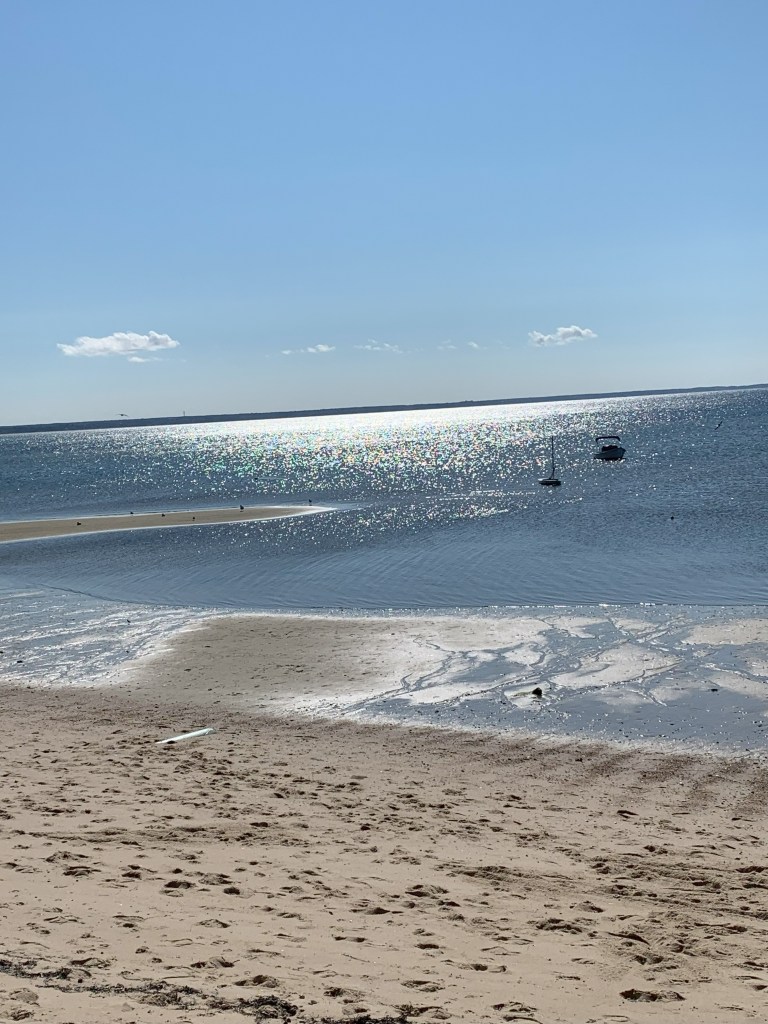
I sit gazing. The world around me asleep except for occasional gulls flying overhead. Stillness surrounds me waiting for the sun to rise. This ocean, the morning before, roiled in protest to darkness disappearing. Today it lies calm, smooth as glass. Two sailboats sit atop the water their hulls mirrored reflections, motionless, tranquil, silent in the absence of wind.
Skies stained with thin veneer of pastel pink await the dawn. As sun’s sliver stealthily appears, skies rouge in excited anticipation. Sliver grows to arc, to half-circle, to orb, and I sigh. Thankful for another day.
Photos taken yesterday morning from our deck in Provincetown on Massachusetts’ Cape Cod.
Written for dVerse, the virtual pub for poets around the globe. Today is Open Link Night and writers are invited to post any poem of their choosing. Bjorn, our pub tender today, also provides an optional prompt you may choose to use.
ALL are invited to dVerse LIVE on Saturday, September September 14th from 10 to 11 AM New York Time. The link to join with audio and video is embedded here. Come and read one of your poems aloud OR come to just sit in and enjoy! The more the merrier!
Star sparkled night sky, overhead silent scrim. Ocean’s dark calm lies before me, laps shore to sleep.
Daylight dawns bright. Gulls call to light, scene transposed. Water sparkle glistens, sun’s fairy dust upon the waves.
Photo: glistening water from our deck in Provincetown this morning.We are in the beginning of our annual two weeks in this beautiful place. Thankful for every day.
Written for dVerse, the virtual pub for writers across the globe. I’m hosting Tuesday Poetics today, asking people to write a poem somehow related to the sea or the ocean. Any form; any length. Simply on the topic of the ocean/sea.
Julia’s delectable mousse au chocolat, my annual nod to France’s Noel.
Best qualité chocolat les oeufs: yolks and whites separated unsalted butter and deep dark espresso splash of citrusy Grand Marnier sugar only to slightly sweeten. Whisking, whisking, beating, beating, licking fingers, licking whisk. Final touch, the folding. Soft-peaked egg whites into sinful chocolate mixture. Airy deliciousness carefully spooned into grandmother’s crystal goblets. Gently placed on refrigerator shelf until its late night serving.
Christmas Eve dinner done. We sit quietly savoring this melt-in-your-mouth dessert. Julia’s delectable mousse au chocolat, our annual nod to France’s Noel.
Written for Tuesday Poetics at dVerse, the virtual pub for poets around the globe. Today, Sanaa is pubtending and asks us to write a poem about food! And yes, I do make Julia’s Mousse au chocolat every Christmas! The page for the recipe in this book is well spattered and smeared with chocolate and has my notes all over it. It is truly delicious!!!
In the stillness I try to quiet my mind. In the stillness I strain to hear your voice, your wisdom, your insight.
In the stillness I am aware of everyday sounds, the clock ticking, the hour chiming, the redbird chirping.
A car passes, time passes, life passes.
Stillness please come and remove all other sounds and let me hear your voice to be my guide this day.
Written by dear friend, Lindsey Ein. I inserted her words in Bing Create and it generated the image. Lindsey will read her poem aloud today at dVerse LIVE.
Come join us at dVerse LIVE today, from 10 to 11 AM New York time. You’ll find the link to join HERE. There’s an audio and video feed and folks from across the US, Pakistan, Australia and the UK have already responded that they’ll be there. Come sit in to listen…..or come read a poem of your choosing. The more the merrier!
Listen carefully, my love as we walk on cool stone slabs curving through the woods. Naturalists laid this path so others could forest bathe, basking in its mesmerizing calm.
Leaves rustle in cooling breeze. Spring waters gurgle somewhere beyond the trees. Yesterday’s rains still moisten fern fronds, brightening their myriad shades of green.
White-breasted nuthatches flit between branches. Their low-whistled notes accompany our slow meandering pace. Hand in hand we walk through serenity, our hearts, our spirits, melding into one.
Written for OLN Thursday at dVerse, the virtual pub for poets around the globe. Today, I’m hosting the pub and folks are free to post any poem of their choosing OR write a poem inspired by one of two photos I’ve provided, the above being one.
NOTE: and if you’d like to see many of our poets in action, come join us LIVE on Saturday morning, August 17th from 10 to 11 AM New York time.Click HERE,and then click on the link given for Saturday’s session. You’ll be connected to audio and video for our live session. Feel free to stop by, just to watch and listen, OR, if you’re so inclined, to read aloud any poem of your choosing. We’re a very friendly bunch. The more the merrier!
. . . remember that old song? Of course you do. Sing it with me! Skip to my Lou, my darlin’!
Let’s skip stones across a pond and then, chalk in hand, draw hopscotch on a sidewalk. Later you can pour me a Scotch and we’ll pour over old photo albums laughing at our childhood antics.
A bit puckered out and perhaps tipsy too, we’ll gawk at the stars, sitting on the stoop. Stooped shoulders with a myriad of wrinkles. Madeline L’Engle’s wrinkles in time singing Skip to my Lou, my darlin’! Oh let’s just skip the malarkey and admit it.
We’re septuagenarians in love with life!
Melissa has us zeugmatically speaking for today’s Poetics at dVerse, the virtual pub for poets around the globe. She explains, “zeugma is defined by Merriam-Webster as ‘a figure of speech in which a word applies to two others in different senses.’ Zeugma is a rhetorical device that is used to emphasize, add humor, or surprise a reader.” Hopefully, I’ve done this correctly with the words skip and pour. The words Scotch, stoop, and wrinkle are played with a bit here as well. Madeline L’Engle’s famous novel, A Wrinkle in Time, is also referenced . . . sort of!
The last of my generation. Savoring my cigarette, I sit blowing smoke rings. They dissipate into wispy nothingness, metaphorical for my existence these days. I’m not alone in this assisted living complex. But I am lonely. With my failing eyesight, I no longer escape on adventures with Agatha Christie or James Patterson.
I have so few pleasures. Sometimes I’ll listen to Duke Ellington records and I’ll bury my soul in a scrapbook with the photographs there. And the moss that I imagine in my dreams, always beneath my husband’s feet. I can see it when I bend over the pages with my magnifying glass, in the picture of John standing beside our first tent. Memories come alive on the pages. My children’s birthday celebrations, cheeks pooched out, blowing candles. I’ve been blessed. My life has been good. But oh Lord, it’s time. It’s time.
Written for Prosery Monday at dVerse, the virtual pub for poets around the globe. Today, Kim asks us to include the line “And I’ll bury my soul in a scrapbook, with the photographs there and the moss” in our piece of flash fiction that is 144 words in length, sans title. The line is from the poem Take This Waltz by Leonard Cohen. We may change the punctuation of the required line, but must use the words exactly, in the exact order as appears in Cohen’s poem.
Psyche jarred by uninvited suitors lips forced upon hers. Anger fired pistons, burned her soul. Robot hand slaps on lipstick. Innocent coral-pink and sweet rose swipes turned crude in thick crimson slashes. Dead autumn brown beside and above brackish burgundy smears. She mouths defeat.
Written for dVerse, the virtual pub for poets around the globe. Today is Quadrille Monday and De asks us to use the word (or a form of the word) “jar” within our poem of exactly 44 words, sans title.
I’m delighted to be back, writing again, after taking a month+ hiatus when we were traveling. Somehow I ended up writing a rather maudlin poem for today.
Today’s quadrille is motivated by Irving Penn’s photo entitled Mouth, taken/produced in New York in 1986. It’s one photo of many that we saw in the exhibit, Fragile Beauty: Photographs from the Sir Elton John and David Furnish Collection, at the Victoria and Albert Museum in London.
Fly with me, my love, once more into the skies to sail upon the seas. Far away lands, new tastes and sounds. Kisses iced with salty breezes, dessert to cap our days. When sun’s warmth wanes, stars will glisten above the wake. Through all our travels when I am with you, I am home.