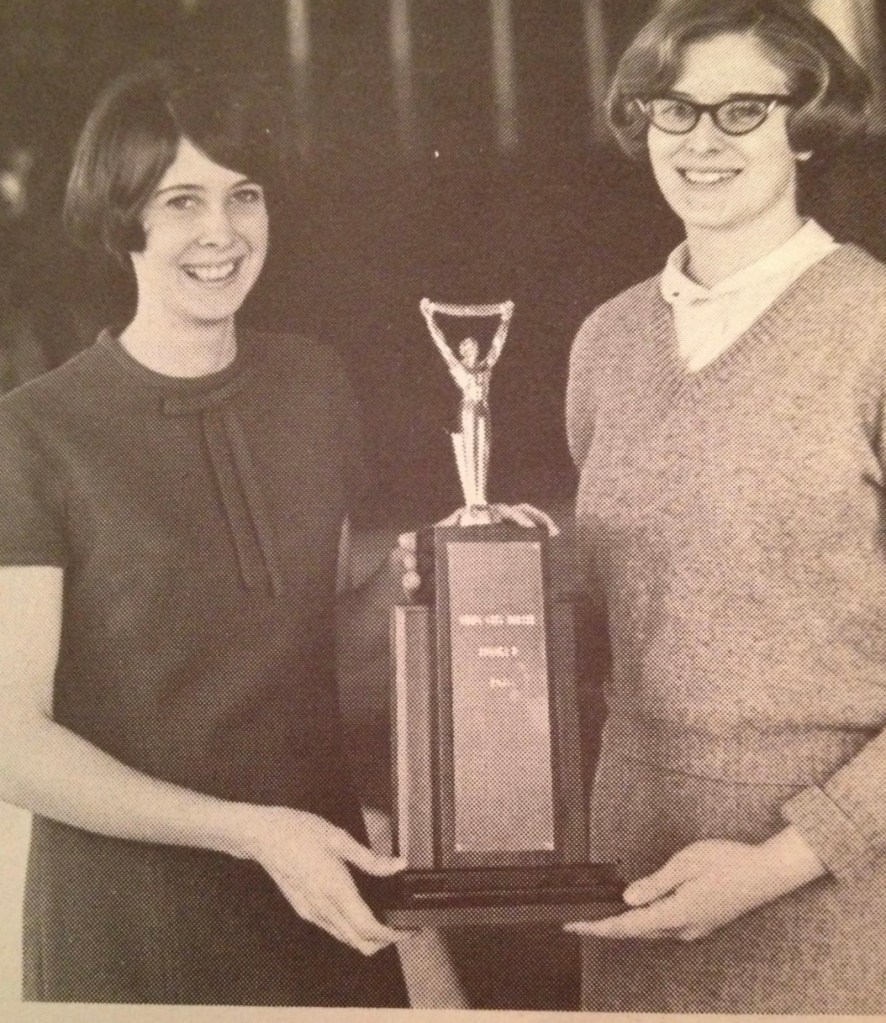
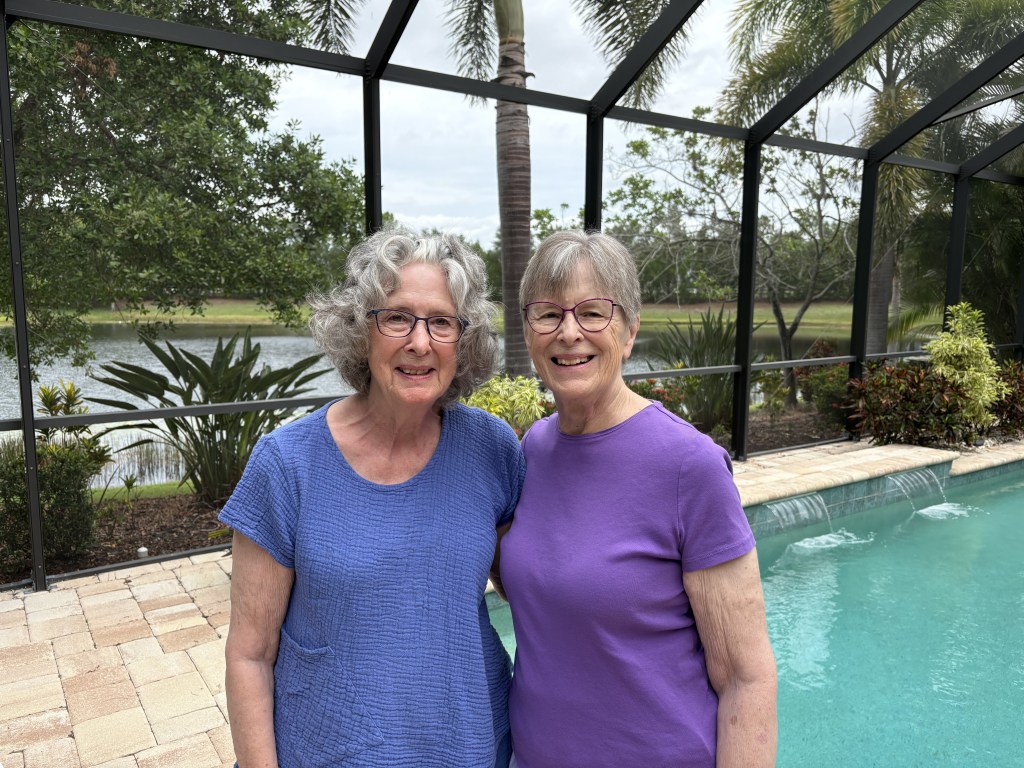
Birds of a feather argumentation our game, friendship scores the win.
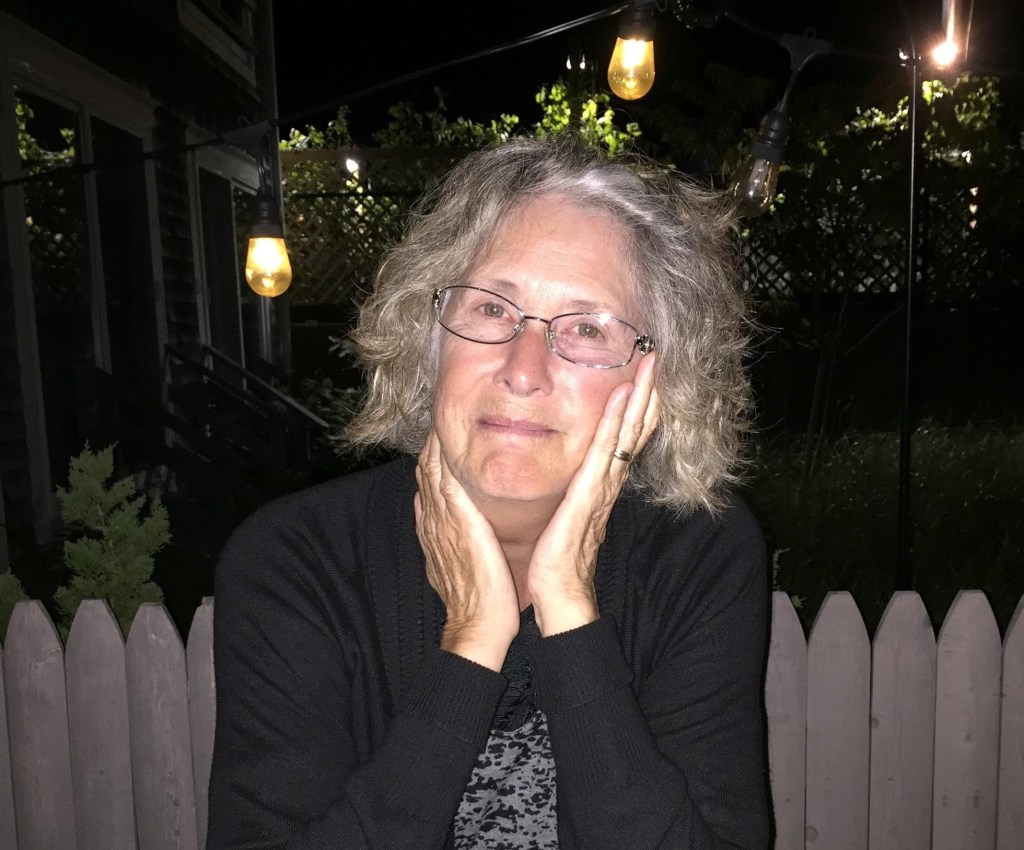
College debate partners from 1965 to 1969. Friendship scores over years and miles – that’s the real trophy in 2026. Just back from a wonderful visit with Karen in Sarasota, Florida.
Shared on dVerse, the virtual pub for poets across the globe.
How do people learn to parent? Do we learn it as we go? Is it a task with diminishing returns?
We erect loving fences round our infants. Envelop them in our arms, nurture them at the breast, cocoon them in swaddled sleep. At varying degrees we watch, hover, interfere or cheer, as they crawl, toddle, run, stumble, fall and get back up again. Fences open as we send them to school. Teachers flick reins with encouragement to lope, gallop, join the race, keep up the pace. Soon fences disappear completely. Children gone more than they’re at home. Is parenting a conundrum? Love and attachment grow stronger every day even as we encourage independence, even as their days with us are numbered. Suddenly they’re adults raising their own as we look on from another place. We hope the path they walked with us was well tread, remembered fondly. We relish our memories as we wait for their muscle memory and that thing called familial love to occasionally nudge them back into our sphere again.
Written for dVerse, the virtual pub for poets around the globe. Today Punam reminds us that in India, May is a month where there will be art exhibits across many cities. She provides us with several artworks that can motivate an ekphrastic poem, or we can be inspired by one of the following names of some of these art shows: 1. Nothing Twice 2. Chance Remains of Another Time 3. Open Fences
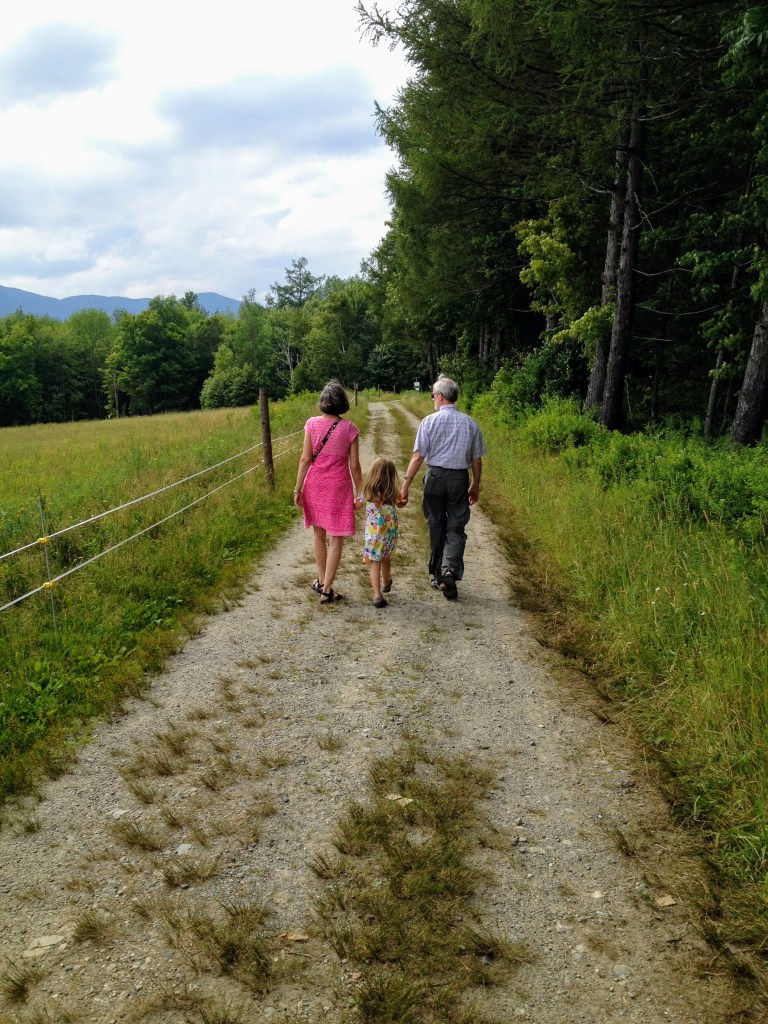
Photo is us with our granddaughter who is now 18! How time flies!
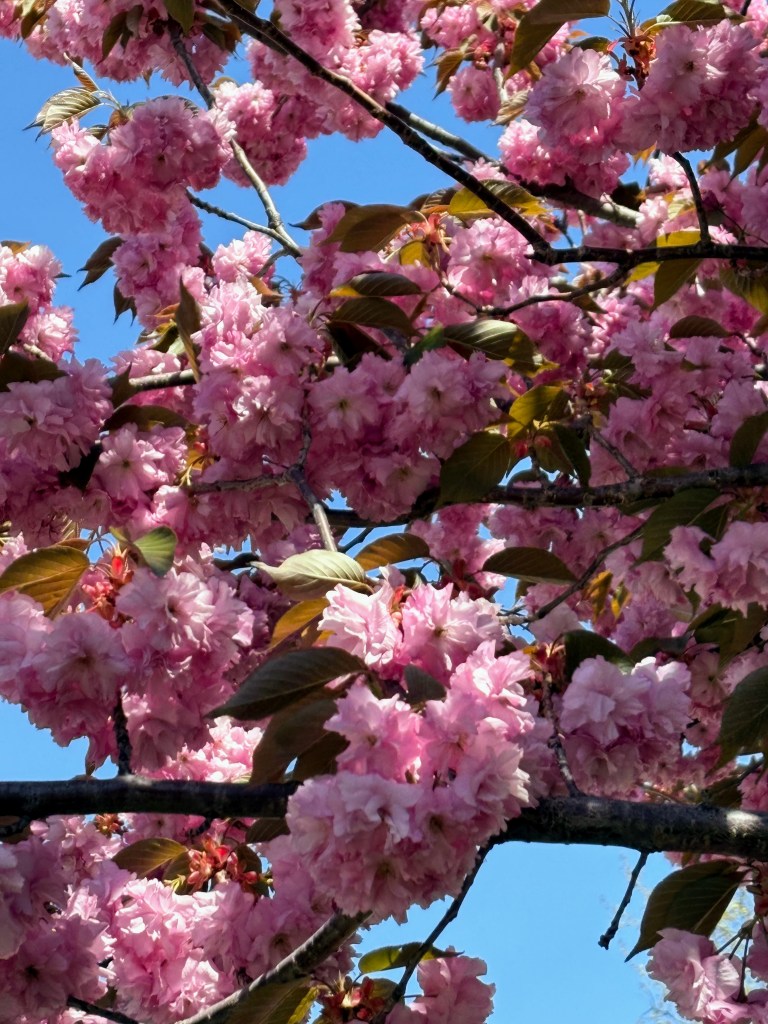
Goodness blooms this time of year. Pushy crocus show off first then tulips admire daffodil ruffles, hyacinths invoke delicious inhales. Trees begin to dress for the occasion. Don magnolia flowers, cherry blossoms, crab apple trees defy their name. We shed coats, walk more sure-footed on warming sidewalks and greening lawns. Infants’ arms wave more freely, cumbersome snowsuit padding gone. Robins appear, geese begin to nest. Mountains’ winter toppings melt, cascade in waterfalls to brooks below. Streams rush over rocks, gurgling their spring symphony. And I, I smile as I step outdoors reveling in another year of life.
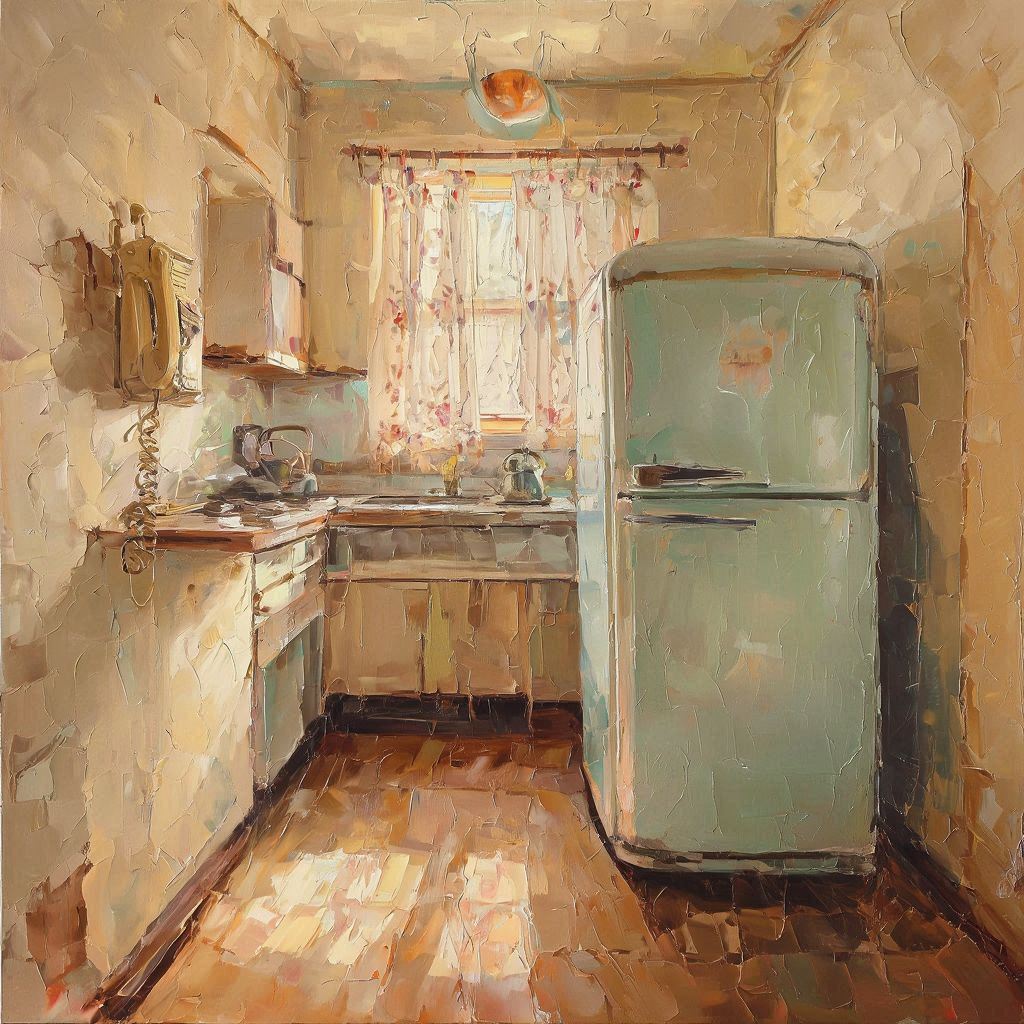
Our first home in Illinois had no front yard. Stepped off the front porch at your own peril, into the dug-out pit for a new college gym. Construction equipment clanged and buzzed constantly digging, laying pipes and beams. Inside, we served visitors spaghetti suppers on our auction bought wiggly table top screwed into four tall two-by-fours. Rotary telephone hung on peeling plastered wall, rarely used for expensive long distance calls. We watched Johnny Carson’s Tonight Show on our nine-inch black and white television. As the old song goes, “Those were the days my friends.”
Fifty-six years later, it’s high-rise condo life. Outside our windows, Boston’s city scape includes trees, few green areas, buildings in every direction. When guests or family arrive, we serve delicious meals with wine at our lovely oak claw-foot dining table. Large screen television streams movies, 24/7 news, sitcoms of every genre. Our handheld “telephone” is a clock, calendar, address book and weather man. It streams music on Spotify. Reaches friends nearby and across the globe with audio and video calls.
Gratefully happy then. Thankfully happy now. So is the old adage true? Things are not better, they’re not worse, they’re just different. What say you?
NAPOWRIMO Day 29. Prompt: In your poem today, compare your everyday present life with your past self, using specific details to conjure aspects of your past and present in the reader’s mind.
Lessons from ancient cultures, wisdom in Native Americans’ ways. Guiding principles to live in harmony passed down from generation to generation.
Debwewin is Truth. Represented by the turtle. The tortoise carries lessons of life on its back. Years piled upon years.
It walks slowly, sometimes laboriously, feet firmly planted in earth’s reality. Its purpose was, still is, forward movement.
Honest plodding, slogging, traipsing at times. Memories, achievements, failures, goals. All stored and carried through life’s journey. No regrets. This is me. In this place. Now.
Everything past, a part of my weight, my girth, my being, my soul.
Written for Tuesday Poetics at dVerse, the virtual pub for poets around the globe. Today Mish is hosting, providing us with a very special prompt that explains The Seven Grandfather Teachings, a set of Anishinaabe guiding principals for living a good life in harmony with nature and others . . . all of creation.
Mish explains: “These ancient teachings have been passed down for generations through stories and ceremonies. Many Native American organizations have adopted these sacred laws as a foundation. Because they are the basis for a worldview rooted in respecting each other and the natural world, these values are often represented by a specific animal. We’re asked to write a poem influenced by the Seven Grandfather Teachings in any way that we would like. We may choose to focus on one or embody them all.“
I’ve chosen to write about Debwewin, Truth, represented by the turtle. “The turtle carries the teachings of life on his back. Slow and meticulous. Understand the importance of the journey. Be true to yourself. Speak your truth.“
These days seem to preclude a circle of love. Iced out. Proliferation of guns. Political strife. Mathemeticians associate Pi with a circle 3.14159 and on and on . . . seemingly out of reach.
Some cite three-hundred-sixty degrees. Others lecture three points required. So many different opinions can the circle be truly delineated?
How to create a circle of love then, much less define the shape itself. Perhaps when two people embrace? When a family of four gathers round a campfire?
Elderly person sitting alone waits for a visit, never to come. But guardian angels gather round faces remembered, comfort in faith.
Circles take effort to make. One person reaching out. More than mathematical equations, perhaps circles are matters of the heart?
NAPOWRIMO Day 27. Prompt: Write a poem in which all the verses contain the same number of lines (whether couplets, triplets, quatrains, etc.) and in which you give the reader instructions of some kind.
In our family, the tradition since our children were very young, has been to sing The Circle of Love as our table grace before our suppers. Hence, the pondering on what is a circle; and how to make a circle. Click here for a recent poem about our Circle of Love tradition. Image by Speedy McVroom from Pixabay
I am not in retirement. I did not re-tire myself. I planned all along to gallop into rejuvenatement, like riding a new steed through bubbling brooks and wildflower fields.
I took the reins. Refused to canter the sedate path, or be put out to pasture in the doldrums of old age. What’s that saying? “You can’t teach an old dog new tricks?”
But I was not an old dog. A poetry class, stabs in the dark at creating a poetry blog, journaling every morning. Then dVerse came along and lillian-the-home-poet was born.
Poetry is more than rhyming, moving words around on the page. It’s pulling out thoughts, sometimes so deep in my psyche I never even knew they were there. It’s a daily communion with self.
No need for adulation, or publication. Poets simply need space, time, reflection, and a way to record. Voice in head transferred to paper or screen, or simply murmured aloud.
If a tree falls in a forest and no one is around to hear it, does it make a sound? If a poet writes a poem and no one is around to read it, does it matter?
I’d answer a resounding yes. Why? Because I believe poetry is a communion with self.
NAPOWRIMO Day 26. Prompt: Write your own ars poetica, giving the reader some insight into what keeps you writing poetry, or what you think poetry should do.
dVerse Poets: the virtual pub for poets around the globe. We offer prompts every Monday, Tuesday, and Thursday and one one LIVE Saturday session per month with audio and video.
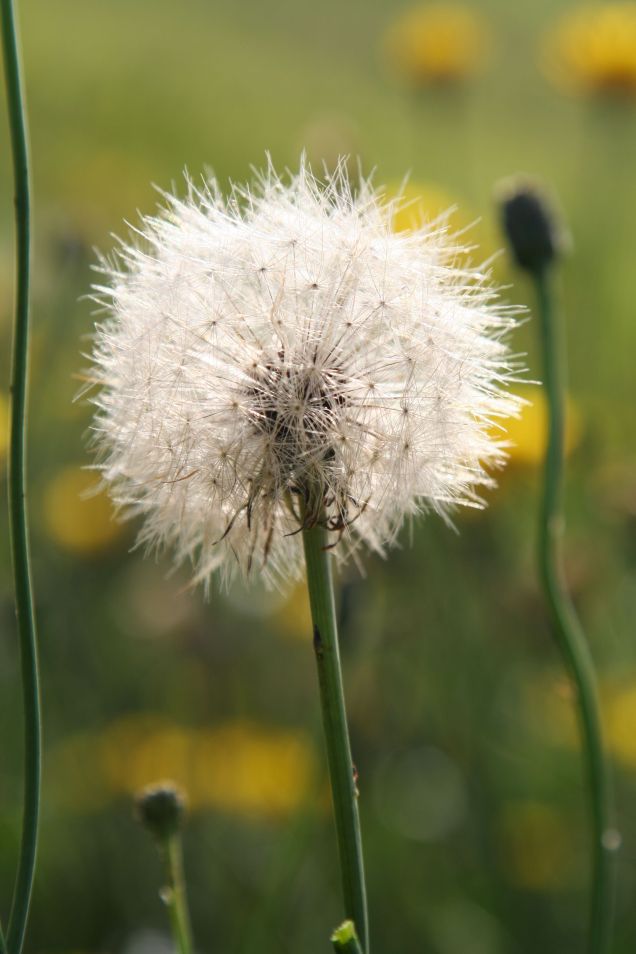
Dandelion me. Youthful glee in splashy yellow dresses. All sunshine and skipping through fields! But old age they say can be grizzly. Those cubs, born hairless and toothless. Grizzly cubs but not grizzly at first. No pacifiers. Mother’s nuzzling enough. Then playful to rambling to belly fat acquired and hibernation needed. I always liked naps. Or acorn me. Digging into soil, finding my own way. Gangly seedling teenage years with autumnal outbreaks. Cacophony of colorful fashion fad flairs. To sentinel oak standing with quiet grace. Am I there yet? I still feel dandy and fierce. Dandy lioness am I. Elderly dandelions’ delicate translucent skin fades slowly until a passing by small child delights in one puff from chubby cheeks. Giggles as seeds soar on spring’s born-again breezes. Dandelionalicious me with walks, hand in hand. Stops along the way to collect bouquets of flowers and skip rocks across the pond. With many smiles. All the while acknowledging life’s delights.
NAPOWRIMO Day 25.Prompt:Write your own poem in which you use at least three metaphors for a single thing, include an exclamation, ruminate on the definition of a word, and come back in the closing line(s) to the image or idea with which you opened the poem.
DEDICATED to my dear friend, Lindsey. Wishing her well.
Metaphors used: comparing my life (anyone’s life) to a dandelion, a grizzly bear, and an acorn growing into an oak tree. Within the grizzly bear section, I ruminate on the meaning of old age. Had fun with this one once I decided how to approach it!
Photo taken many many years ago. And yes, it’s a dandelion in its old age!
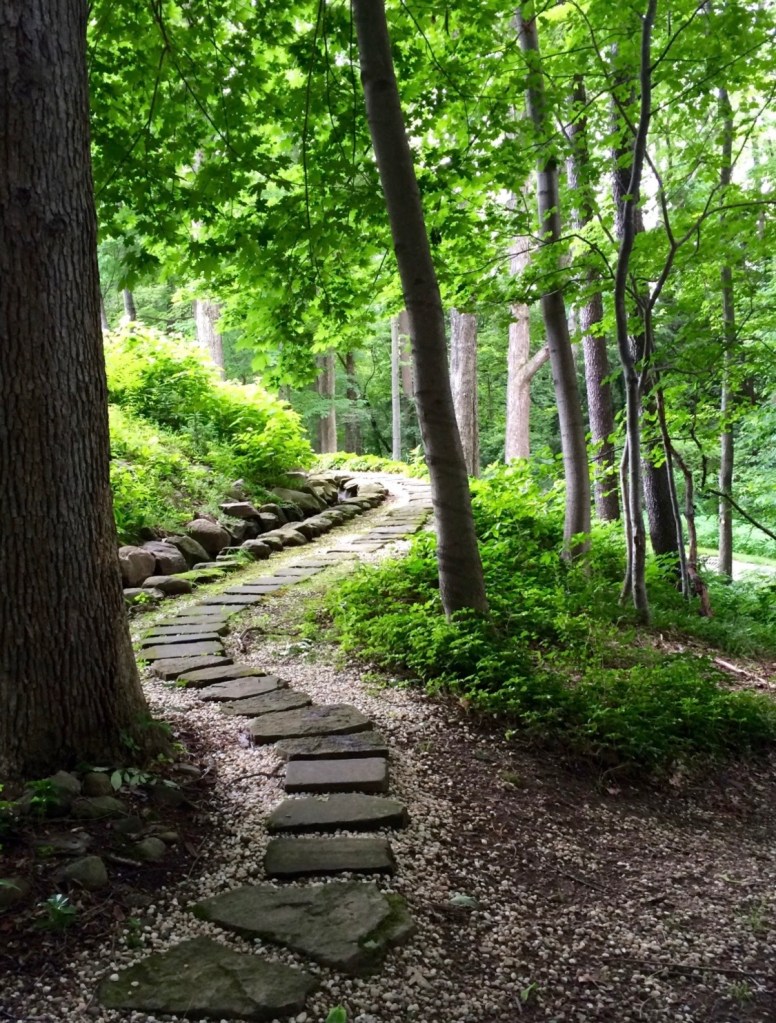
Come walk this path with me through wooded quiet calm. It will lend its peace to you.
Canopy of green leaves gleam as sunlight filters through. Come walk this path with me.
Morning’s quiet coolness will ease and soothe the soul. It will lend its peace to you.
Some call it forest bathing, five senses engaged in meditation. Come walk this path with me.
Immerse ourselves knowing Earth’s beauty nurtures best. It will lend its peace to you.
Escape the city’s frenzy find nature’s solemnity. Come walk this path with me, it will lend its peace to you.
NAPOWRIMO Day 22.Prompt is to write a Villanelle. Photo from a vacation we took some years ago.
Villanelle: A French verse form consisting of five three-line stanzas and a final quatrain. The first and third lines of the first stanza repeat alternately in the following stanzas. And these two lines form the final couplet in the quatrain. It’s a poetic sudoku!
Mother named me Lillian her mother’s namesake. My father’s twin sister’s moniker as well, much to my mother’s chagrin. She chose the middle name of Mae after a favorite aunt, the likes of who I don’t recall. But because of her, twelve cousins called me Lilly Mae. To everyone else, I was Lillian
The momentous moment of change came when my parents left me on my own to begin my college days. First person I met on that idyllic campus, I announced my name as Lill and that’s who I became. Years later, titles attached themselves. Mrs. Hallberg, high school teacher. Dr. Hallberg, the PhD kind. Dean Hallberg, career topper.
Now rejuvenated (never say retired) I’m happily back to Lill. Except when I’m lillian-the-home-poet. Capitalization not preferred because after all, it’s just me.
NAPOWRIMO Day 21. Prompt:Write a poem in which you muse on your name and nicknames you’ve been given.
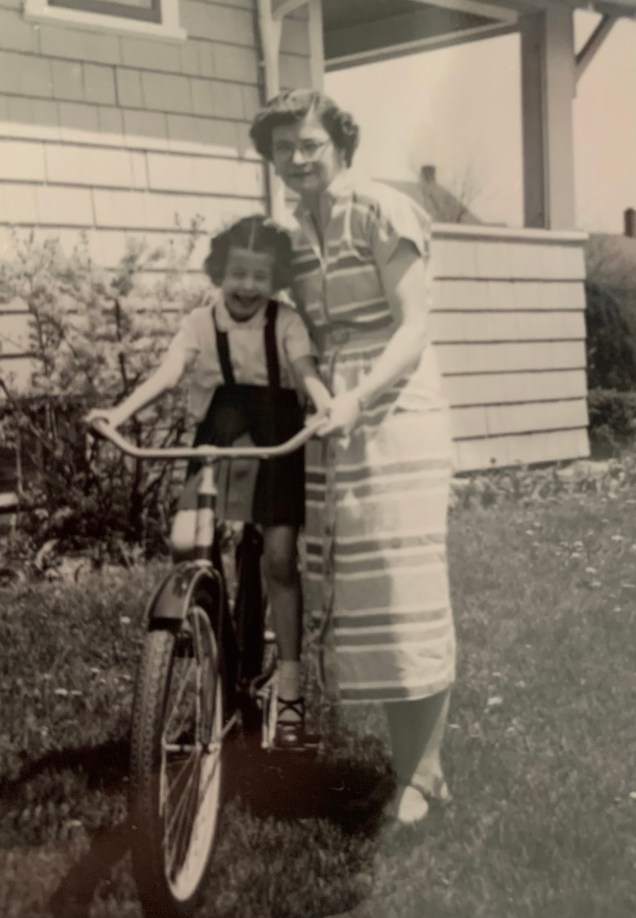
PHOTO of my mother and I and my new two-wheeler bicycle. From tricycle to this. In the 1950s, either they didn’t have small bikes or “training wheels” for kids to learn on or else my folks could only afford to buy me one “big girl’s bike”. One distinct memory I have of my childhood is my dad hanging on to the back of this bike, running along on the sidewalk while I was trying to balance, feeling like I was flying and then looking back and seeing him half-way down the block behind me! I don’t recall if I immediately fell or not….I just remember that feeling and then seeing him so far away, realizing I was riding on my own!